


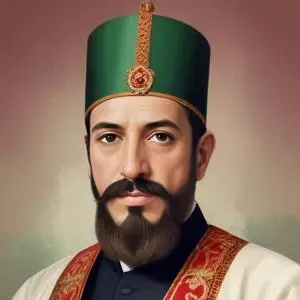
The 34th Sultan of the Ottoman Empire was a reform-minded ruler who modernized his country's education, law, and infrastructure, while also suppressing opposition and dissent. He's infamous for his role in the Hamidian massacres of Armenians.
Known as the last sultan to exert effective control over the Ottoman Empire, Abdul Hamid II ruled from 1876 to 1909, overseeing a period of decline and turmoil, yet also implementing significant modernizations and centralizations. His reign was marked by a complex mix of reform and repression, earning him both admiration and condemnation from his contemporaries.
Elevated to the throne in the wake of the Young Ottoman coups, Abdul Hamid II promulgated the Ottoman Empire's first constitution during the Tersane Conference, showcasing his early commitment to progressive thinking. This move was seen as a significant step towards modernization and democratization, and it earned him initial support from the liberal-minded Young Ottomans.
However, his enthronement coincided with the Great Eastern Crisis, which began with the Empire's default on its loans, uprisings by Christian Balkan minorities, and a war with the Russian Empire. At the end of the crisis, Ottoman rule in the Balkans and its international prestige were severely diminished, and the Empire lost its economic sovereignty as its finances came under the control of the Great Powers through the Ottoman Public Debt Administration.
In response, Abdul Hamid II consolidated his rule by suspending both the constitution and the parliament, purging the Young Ottomans, and curtailing the power of the Sublime Porte. He ruled as an absolute monarch for three decades, justifying his actions as necessary to maintain order and stability in the face of internal and external threats.
Despite his authoritarian tendencies, Abdul Hamid II oversaw significant modernizations and centralizations during his reign. He implemented reforms in the bureaucracy, extended the Rumelia Railway and the Anatolia Railway, and constructed the Baghdad Railway, connecting the Empire's distant provinces like never before. These projects demonstrated his commitment to modernizing the Ottoman Empire and bridging the gap between its European and Asian territories.
A devout Islamist, Abdul Hamid II asserted his title of Caliph to Muslims around the world, solidifying his position as the spiritual leader of the Islamic community. This move helped to bolster his legitimacy and appeal to theEmpire's vast Muslim population, while also fostering a sense of pan-Islamic unity.
However, Abdul Hamid II's reign was also marked by increasing paranoia and repression. Fearing plots to overthrow him, he created secret police organizations and implemented a censorship regime, stifling dissent and opposition. This atmosphere of fear and intimidation earned him the nickname "the Red Sultan" and made him widely unpopular among the Empire's Christian and liberal subjects.
Abdul Hamid II's complex and often contradictory legacy continues to inspire debate among historians and scholars. While he implemented significant modernizations and centralizations, he also repressed dissent and opposition, contributing to the Empire's eventual decline. Nevertheless, his impact on the Ottoman Empire's development and its relationship with the wider world remains undeniable.
"I am not a ruler, I am the Sultan of the Ottoman Empire. I am the Caliph of the Muslims. I am the defender of the faith."
This quote, often attributed to Abdul Hamid II, captures his sense of duty and responsibility as the leader of the Ottoman Empire and the Islamic world.
Abdul Hamid II's life and reign were marked by significant events and milestones, shaping the course of the Ottoman Empire and its legacy.
Born in 1326
The founder of the Ottoman Empire's expansionist era, known for conquering much of the Balkans and establishing the Ottoman state as a dominant power in the region.
Born in 1842
An Ottoman administrator, intellectual, art expert, and painter who pioneered Turkish archaeology and museum curation, and created iconic Orientalist paintings. He's a cultural bridge between East and West.
