


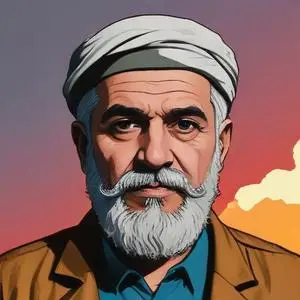
A founder of the Kurdistan Workers' Party, he led a militant separatist movement in Turkey, sparking a decades-long conflict. He's known for his controversial ideology and imprisonment.
Abdullah Öcalan, also known as Apo, is a Turkish-Kurdish politician and the founding member of the militant Kurdistan Workers' Party (PKK). He led the party into the Kurdish-Turkish conflict in 1984 and has been a prominent figure in the struggle for Kurdish rights and autonomy in Turkey.
Öcalan was born on April 4, 1949, in the village of Amara, in the Halfeti district of Şanlıurfa Province, in eastern Turkey. His early life and education are not well-documented, but it is known that he developed an interest in politics and social justice from a young age.
In 1978, Öcalan co-founded the PKK, which initially sought to establish an independent Kurdish state in Turkey. The party's goals later shifted to focus on autonomy and democratic rights for the Kurdish population within Turkey's borders.
Öcalan led the PKK during the Kurdish-Turkish conflict, which began in 1984. He was based in Syria from 1979 to 1998, where the PKK received sanctuary and support from the Syrian government. In 1998, Turkey threatened to invade Syria if Öcalan was not expelled, and he was eventually forced to leave.
In February 1999, Öcalan was abducted by the Turkish National Intelligence Organization (MIT) in Nairobi, Kenya, and imprisoned on İmralı Island in Turkey. He was sentenced to death under Article 125 of the Turkish Penal Code, but the sentence was commuted to aggravated life imprisonment when Turkey abolished the death penalty.
Öcalan has developed a philosophical framework known as "democratic confederalism," which advocates for a decentralized, democratic system of governance. He has also written extensively on the concept of "jineology," or the science of women, which is a form of feminism that emphasizes women's autonomy and empowerment.
From prison, Öcalan has published several books on politics, philosophy, and history. He has also been involved in negotiations with the Turkish government, which led to a temporary Kurdish-Turkish peace process in 2013.
Öcalan's ideas and leadership have had a significant impact on the Kurdish movement and the broader struggle for democratic rights and autonomy in Turkey. His philosophy of democratic confederalism has inspired movements and organizations around the world.
Öcalan's legacy is complex and contested, with some regarding him as a hero and others as a terrorist. However, his impact on the Kurdish movement and the struggle for democratic rights and autonomy in Turkey is undeniable. His ideas and leadership continue to inspire and influence social and political movements around the world.
Despite his imprisonment, Öcalan remains a key figure in the Kurdish movement and a symbol of resistance against oppression. His story serves as a testament to the power of human spirit and the importance of fighting for social justice and human rights.
