


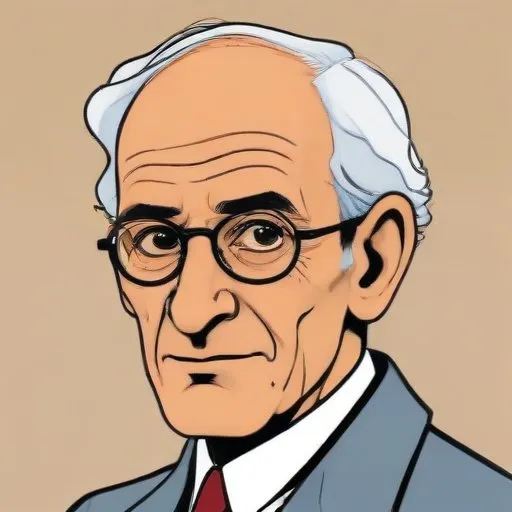
Developed set theory and introduced the Zermelo-Fraenkel axioms, which form the foundation of modern mathematics.
Abraham Fraenkel, a German-born Israeli mathematician, is renowned for his groundbreaking contributions to axiomatic set theory, particularly his additions to Ernst Zermelo's axioms, which culminated in the Zermelo-Fraenkel set theory. This fundamental work has had a profound impact on modern mathematics, shaping the foundation of set theory and influencing subsequent mathematical discoveries.
Born on February 17, 1891, in Munich, Germany, Fraenkel demonstrated a keen interest in mathematics from an early age. He pursued his passion at the Universities of Munich, Berlin, Marburg, and Breslau, where he studied mathematics. After completing his education, Fraenkel lectured at the University of Marburg from 1916 and rose to the position of professor in 1922.
Fraenkel's early work focused on Kurt Hensel's p-adic numbers and the theory of rings. However, it was his work on axiomatic set theory that catapulted him to prominence. In 1919, he published his seminal work, "Einleitung in die Mengenlehre" (Introduction to Set Theory), which laid the foundation for his subsequent contributions. In 1922 and 1925, Fraenkel published two papers that sought to improve Zermelo's axiomatic system, resulting in the Zermelo-Fraenkel axioms.
The Zermelo-Fraenkel axioms, also known as ZFC, are a set of nine axioms that provide the foundation for modern set theory. These axioms, which include the axiom of extension, the axiom of pairing, and the axiom of choice, among others, have become the standard framework for set theory. Fraenkel's contributions to ZFC have had far-reaching implications, influencing numerous areas of mathematics, including algebra, geometry, and analysis.
In 1929, Fraenkel made the significant decision to join the Hebrew University of Jerusalem, where he spent the remainder of his career. He became the first dean of the faculty of mathematics and later served as rector of the university. Fraenkel was an ardent Zionist and actively participated in Jewish National Council and the Jewish Assembly of Representatives under the British mandate. He was also affiliated with the Mizrachi religious wing of Zionism, which promoted Jewish religious education and schools.
Fraenkel received numerous accolades for his contributions to mathematics, including the Israel Prize in 1956. He was also elected as a member of the Israel Academy of Sciences and Humanities.
Abraham Fraenkel's pioneering work on axiomatic set theory has left an indelible mark on modern mathematics. His contributions have shaped the foundation of set theory, influencing generations of mathematicians and paving the way for subsequent breakthroughs. Today, Fraenkel's legacy continues to inspire mathematicians and scholars, serving as a testament to the power of human ingenuity and intellectual curiosity.
Born in 1862
A renowned mathematician and academic who developed infinite-dimensional vector spaces and laid the foundation for quantum mechanics and relativity. He's also famous for his 23 unsolved math problems that shaped 20th-century mathematics.
Born in 1845
Developed set theory, introducing infinite sets and cardinal numbers, revolutionizing mathematics and philosophy.
Born in 1831
Developed a rigorous definition of real numbers and introduced the concept of Dedekind cuts, revolutionizing mathematics and laying the foundation for modern analysis. His work also explored the nature of infinity and the foundations of mathematics.
Born in 1872
A renowned thinker who made significant contributions to mathematics, philosophy, and social commentary, known for his influential writings on logic, ethics, and politics. He's a prominent figure in shaping modern intellectual thought.
Born in 1906
A groundbreaking logician and philosopher who shook the foundations of mathematics with his incompleteness theorems, proving that no formal system can be both complete and consistent.
Born in 1885
A pioneer in combining mathematics and physics, known for his work on quantum mechanics, relativity, and the philosophy of science. He introduced the concept of gauge theory, which is crucial in modern particle physics.
Born in 1882
A pioneering mathematician and physicist who revolutionized abstract algebra and made groundbreaking contributions to modern physics, particularly in the development of Einstein's theory of general relativity.
