


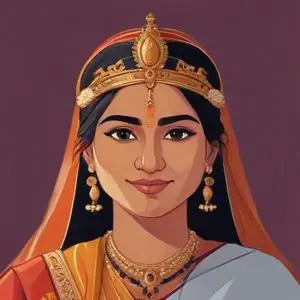
A courageous and wise leader who expanded her kingdom through strategic alliances and military campaigns, while also promoting education, art, and architecture. She is revered for her progressive policies and philanthropic efforts.
Ahilyabai Holkar, the 18th-century queen of Malwa, is revered for her exemplary courage, administrative prowess, and patronage of Hindu temples and Dharmashalas across the Indian subcontinent. She is celebrated as a pioneering figure who shattered traditional gender barriers, defending her kingdom against intruders and personally leading armies into battle.
Born on May 31, 1725, in the Chaundi village of present-day Ahmednagar district, Maharashtra, Ahilyabai belonged to a Marathi Hindu family. Her father, Mankoji Shinde, a scion of a respectable Dhangar Gadariya family, served as the Patil and taught Ahilyabai to read and write, despite women being denied education during that era.
Legend has it that Malhar Rao Holkar, a commander in the army of Maratha Peshwa Baji Rao, spotted the eight-year-old Ahilyabai at a temple service and was impressed by her piety and character. On the Peshwa's advice, Ahilyabai married Khande Rao Holkar, Malhar Rao's son, in 1733.
After the demise of her husband and father-in-law, Ahilyabai took charge of the Holkar dynasty's affairs, establishing Maheshwar in Madhya Pradesh as the seat of the Holkar Dynasty. Under her leadership, Maheshwar flourished as a center of commerce, art, and culture.
Ahilyabai is renowned for her patronage of Hindu temples and Dharmashalas, constructing numerous structures across the Indian subcontinent. Her architectural endeavors not only reflected her devotion to Hinduism but also promoted cultural and spiritual harmony.
With Tukoji Rao Holkar as her military commander, Ahilyabai led armies into battle, defending the Malwa state against intruders and safeguarding its sovereignty. Her diplomatic prowess enabled her to forge alliances and maintain peaceful relations with neighboring kingdoms.
Ahilyabai's remarkable achievements are all the more significant considering the rigid gender norms of 18th-century India. By undertaking administrative and military responsibilities, she paved the way for future generations of women to challenge traditional gender roles.
Ahilyabai's life and works are a testament to her unwavering faith in Hinduism and her commitment to promoting social welfare and cultural heritage. Her architectural projects, temples, and Dharmashalas embody her philosophical convictions, reflecting her vision for a harmonious and prosperous society.
Ahilyabai Holkar's enduring legacy extends beyond her impressive architectural achievements and military conquests. She remains an iconic figure, inspiring generations with her courage, compassion, and leadership. Her contributions to Indian history, culture, and society continue to be celebrated and revered.
Ahilyabai Holkar's life is a testament to her unwavering dedication to her kingdom, her people, and her faith. As a trailblazing queen, she has left an indelible mark on Indian history, inspiring future generations to emulate her courage, compassion, and leadership.
Born in 1693
A powerful Maratha nobleman who played a crucial role in Indian history, particularly in the 18th century, and is remembered for his bravery and military prowess. He expanded his kingdom, conquering many territories and leaving a lasting legacy.
Born in 1524
A 16th-century Indian queen who bravely fought against the Mughal Empire, leading her army into battle and sacrificing her life for her kingdom's freedom. She's a legendary symbol of courage and patriotism in Indian history.
Born in 1700
The founder of the Maratha Empire, a powerful Indian kingdom, who expanded its territories through military campaigns and clever diplomacy. He is revered for his strategic brilliance and administrative reforms.
