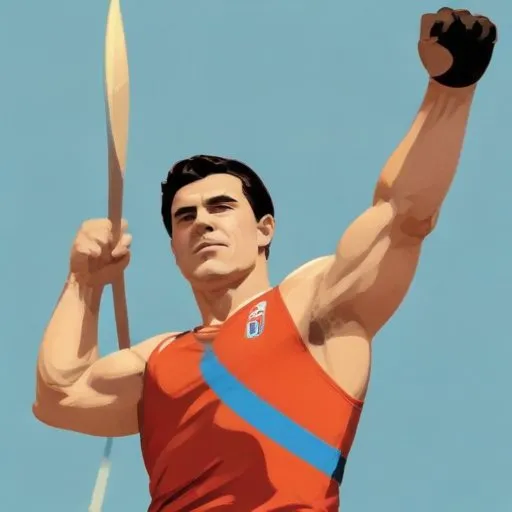
Al Cantello: The Javelin Legend Who Threw His Way into History
Unleashing the Power of the Javelin
Al Cantello, a name synonymous with excellence in the world of javelin throwing, is renowned for his incredible athletic prowess and dedication to the sport. As a member of the United States Marine Corps, Cantello's remarkable journey would take him to the pinnacle of success, etching his name in the annals of track and field history.
Early Achievements
Born on June 9, 1931, Cantello's fascination with the javelin began during his college days at La Salle University in Philadelphia, where he graduated in 1955. His exceptional talent and rigorous training earned him a spot on the US Olympic team for the 1960 Summer Olympics in Rome. Although he finished tenth in the finals, Cantello's remarkable throw of 79.72m in the qualifying rounds still stands as one of the longest in Olympic history.
A World Record Holder and Coach Extraordinaire
Cantello's crowning glory came in 1959 when he set a world record in the javelin with a throw of 86.04m in Compton. This phenomenal achievement earned him the title of the world's greatest competitor in the javelin, as voted by Sport magazine in 1964. His unique throwing style, characterized by his whole-body involvement and semihandstand landing, set him apart from his peers.
As a coach, Cantello's impact was just as profound. His 50-year tenure at the United States Naval Academy saw him guide the men's distance running program to unprecedented heights, earning him three NCAA Mid-Atlantic Coach of the Year awards.
Awards and Accolades
- 1959: AAU title winner
- 1960: AAU title winner
- 1964: Named to Sport magazine's all-time track and field team
- 2013: Inducted into the U.S. Track & Field and Cross Country Coaches Association (USTFCCCA) Coaches Hall of Fame
Legacy and Impact
Cantello's remarkable journey has inspired countless athletes and coaches alike. His commitment to the sport has left an indelible mark on the world of track and field, cementing his status as a legendary figure. Even in his later years, Cantello remained dedicated to the sport, continuing to coach and inspire until his retirement in 2018.
Al Cantello's remarkable life journey came full circle on January 17, 2024, when he passed away at the age of 92, leaving behind a rich legacy that will continue to inspire future generations of athletes and coaches.
Remembering the Man Behind the Javelin
While Cantello's impressive athletic achievements and coaching accomplishments are well-documented, it is his unwavering dedication, perseverance, and passion for the sport that truly define him. As we reflect on his remarkable life, we are reminded of the power of human spirit and the enduring impact one individual can have on the world.
FAQ
What were Al Cantellos achievements in athletics?
Al Cantello was a talented javelin thrower who won several national championships in the United States. He also competed in the Olympic Games, finishing sixth in the 1960 Rome Olympics.
What coaching career did Al Cantello have?
Al Cantello went on to become a successful coach, serving as the head coach of the University of Southern Californias track and field team from 1964 to 1984. He led the team to several national championships and produced many Olympic athletes.
What awards did Al Cantello receive?
Al Cantello received the United States Track and Field and Cross Country Coaches Associations (USTFCCCA) Coach of the Year award in 1976. He was also inducted into the USA Track & Field Hall of Fame in 1990.
How did Al Cantello contribute to the development of javelin throwing?
Al Cantello was known for his innovative coaching techniques and training methods, which helped to improve the performance of many javelin throwers. He also developed several training aids and equipment that are still used today.
What is Al Cantellos legacy in athletics?
Al Cantello is remembered as one of the greatest javelin throwers and coaches in American athletics history. He is known for his contributions to the sport, including his innovative coaching techniques and his production of many Olympic athletes.