


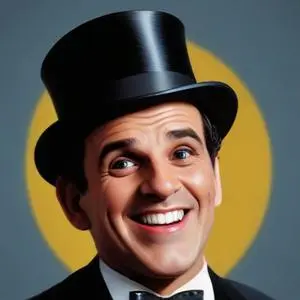
A legendary performer who charmed audiences with his powerful voice and charismatic stage presence, starring in the first "talkie" film, The Jazz Singer, and popularizing jazz and blues music.
Al Jolson, born Asa Yoelson, was a Lithuanian-born American singer, actor, and vaudevillian who rose to fame in the 1920s as one of the United States' most famous and highest-paid stars. He was self-billed as "The World's Greatest Entertainer," and his shamelessly sentimental, melodramatic approach towards performing, as well as his ability to popularize many of the songs he sang, made him a household name.
Jolson was born on May 26, 1886, in Seredžius, Lithuania, to a Jewish family. He immigrated to the United States with his family at the age of seven and grew up in Washington, D.C. He began his career in show business at the age of 15, performing in local theaters and vaudeville circuits.
Jolson's big break came in 1911 when he landed a role in the Broadway show Dancing Around. His energetic and charismatic performances quickly made him a favorite among audiences and critics alike. He went on to star in numerous Broadway shows, including The Honeymoon Express and Robinson Crusoe Jr., cementing his status as a rising star.
In 1927, Jolson starred in the first talking picture, The Jazz Singer, which revolutionized the film industry and catapulted Jolson to international fame. The film's success was largely due to Jolson's dynamic performance, which showcased his unique blend of singing, dancing, and acting.
Jolson continued to star in a series of successful musical films throughout the 1930s, including The Singing Fool, Say It with Songs, and Hollywood Revue of 1929. After a brief period of inactivity, his stardom returned with the biographical film The Jolson Story in 1946, in which Larry Parks played the younger Jolson, but with sung vocals dubbed by Jolson himself. The formula was repeated in the sequel Jolson Sings Again in 1949.
During World War II, Jolson was the first star to entertain troops overseas, performing for soldiers in Europe and Africa. He repeated this feat during the Korean War, performing 42 shows in 16 days and earning the Medal for Merit from Defense Secretary George Marshall.
Jolson's impact on popular music and culture cannot be overstated. He was a pioneer in popularizing jazz and blues music to white American audiences, paving the way for future generations of musicians. His dynamic style of singing and performing influenced countless artists, including Bing Crosby, Frank Sinatra, and Elvis Presley.
Jolson's legacy is also marked by controversy, as he perpetuated black stereotypes through his use of blackface makeup in his performances. Despite this, his work was often well-regarded by black publications, and he was praised for his ability to bring African-American music to a wider audience.
Jolson married four times and had three children. He died on October 23, 1950, at the age of 64, due to complications from a heart attack, partly owing to the physical exhaustion from his grueling performance schedule.
Al Jolson's impact on popular culture and entertainment is still felt today, and his legacy continues to inspire new generations of performers and musicians. Despite controversy and criticism, Jolson remains an important figure in American entertainment history, and his contributions to the world of music and film are undeniable.
Born in 1903
Smooth-voiced crooner who dominated the music charts and silver screen with his warm, baritone voice and iconic Christmas tunes.
Born in 1903
A legendary entertainer who brought laughter and joy to millions through his iconic comedy specials, films, and USO tours, leaving a lasting impact on American entertainment.
Born in 1915
A legendary entertainer who charmed audiences with smooth vocals and iconic film roles, leaving an indelible mark on American popular culture.
Born in 1917
A legendary entertainer, known for smooth vocals, charming on-screen presence, and iconic Rat Pack performances, leaving a lasting impact on the music and film industries.
Born in 1926
A legendary comedian and actor, best known for his slapstick humor, impressive physical comedy, and iconic films like "The Nutty Professor" and "Martin and Lewis" duo with Dean Martin.
Born in 1892
A popular entertainer of the 1920s-1940s, known for his charismatic stage presence, catchy songs, and comedic timing, starring in films, Broadway shows, and radio programs.
Born in 1896
A legendary comedian and entertainer, known for his quick wit, charming stage presence, and iconic cigar, starring in films and TV shows that brought laughter to generations.
Born in 1895
A zany comedian and actress who delighted audiences with her witty banter and comedic timing on stage, screen, and radio, particularly in the 1930s and 1940s.
