


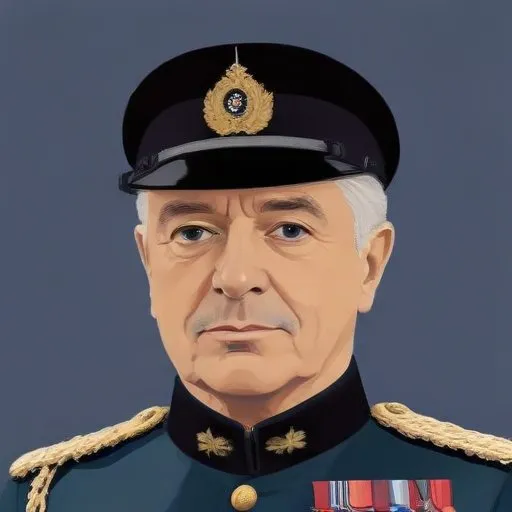
A renowned French-English field marshal and politician who played a crucial role in World War II, serving as Chief of the Imperial General Staff and advising Winston Churchill. He's also known for his diplomatic efforts and post-war political career.
Alan Brooke, 1st Viscount Alanbrooke, was a renowned British Army officer who served as the Chief of the Imperial General Staff (CIGS) during World War II, playing a pivotal role in shaping Britain's military strategy and ultimately contributing to the Allied victory in 1945. As Chairman of the Chiefs of Staff Committee, Brooke was the most trusted military advisor to Prime Minister Winston Churchill, and his sharp mind and unwavering dedication earned him the respect of his peers and the gratitude of a nation.
Born on July 23, 1883, in Bagnères-de-Bigorre, Hautes-Pyrénées, France, to a prominent Anglo-Irish family with a rich military tradition, Brooke was destined for greatness. The youngest of seven siblings, he was raised in a bilingual environment, speaking French and English fluently, with a distinct Gascon accent. This linguistic proficiency would later serve him well in his diplomatic and military endeavors.
Brooke's military career began in 1902, when he joined the Royal Artillery. He saw action in World War I, participating in the Battle of the Somme and the Battle of Cambrai. His exceptional leadership and tactical prowess earned him rapid promotion, and by the outbreak of World War II, he had risen to the rank of Lieutenant-General, commanding the II Corps in France.
Brooke's war diaries, kept between 1939 and 1946, provide a unique insight into the mind of a military strategist and the intricacies of wartime politics. These candid and often scathing accounts of his experiences, including his criticisms of Churchill and other prominent figures, have been the subject of much fascination and debate among historians and military enthusiasts.
Brooke's illustrious career was marked by numerous distinctions and honors, including his appointment as Field Marshal in 1944, Knight Grand Cross of the Order of the Bath in 1946, and Viscount Alanbrooke in 1946. He also served as Lord High Constable of England during the Coronation of Queen Elizabeth II in 1953.
Alan Brooke's legacy extends far beyond his wartime accomplishments. His leadership and vision helped shape the course of modern British history, and his influence can still be felt in the country's military and political establishments. As a testament to his enduring impact, the Brookeborough War Memorial in County Fermanagh, Northern Ireland, stands as a poignant reminder of his service and sacrifice.
In conclusion, Alan Brooke, 1st Viscount Alanbrooke, was a towering figure in British military history, whose strategic genius, unwavering dedication, and leadership played a pivotal role in the Allied victory in World War II. His lasting legacy continues to inspire generations of military leaders, politicians, and historians alike.
Born in 1871
Prolific writer of historical novels and adventure stories, also a talented landscape painter.
Born in 1890
Led the Allied forces to victory in World War II and later served as President, maintaining peace and prosperity during the Cold War era. He's known for his strategic leadership and diplomatic skills.
Born in 1885
A renowned military leader who played a crucial role in World War II, particularly in the Allied victory in Europe, known for his bold tactics and unapologetic style.
Born in 1883
Led the Labour Party to a landslide victory in 1945, implementing significant social and economic reforms, including the creation of the National Health Service. He played a crucial role in shaping post-war Britain.
Born in 1897
A British politician who served as Prime Minister from 1955 to 1957, known for his role in the Suez Crisis and his diplomatic efforts during the Cold War.
