


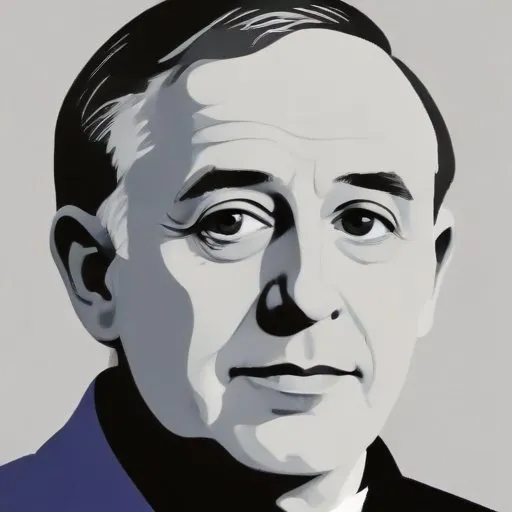
A philosopher who challenged modern moral philosophy by arguing that morality is rooted in tradition and community, and that we need to revive the Aristotelian concept of virtues to live a good life.
Alasdair MacIntyre is a Scottish-American philosopher renowned for his groundbreaking work in moral and political philosophy, particularly with his seminal book, After Virtue, published in 1981. This influential work reinvigorated the concept of virtue ethics, challenging the prevailing moral philosophies of the time and shaping the trajectory of contemporary moral and political thought.
MacIntyre was born on January 12, 1929, in Glasgow, Scotland, to Eneas and Greta Chalmers MacIntyre. He pursued his higher education at Queen Mary College, London, and later earned his Master of Arts degrees from the University of Manchester and the University of Oxford.
MacIntyre's academic career spanned multiple institutions, including the University of Manchester, University of Leeds, University of Essex, and University of Oxford in the UK, and later in the US, at Brandeis University, Duke University, Vanderbilt University, and Boston University. He has held various distinguished positions, including Professor of History of Ideas, Dean of the College of Arts, and McMahon-Hank Professor of Philosophy.
His major works include A Short History of Ethics (1966), Against the Self-Images of the Age (1971), and Whose Justice? Which Rationality? (1988). However, it is After Virtue that catapulted him to prominence, offering a trenchant critique of modern moral philosophy and proposing a neo-Aristotelian approach to ethics.
MacIntyre's philosophical contributions are characterized by his rejection of modern moral philosophy's emphasis on individualism, liberalism, and emotivism. Instead, he advocates for a virtues-based approach, rooted in Aristotelian and Thomistic traditions. He argues that moral judgments should be guided by a telos, or inherent purpose, rather than by abstract principles or utility.
MacIntyre's thought is also marked by his critique of Enlightenment rationality, which he considers flawed and unable to provide a coherent moral framework. He instead recommends a more nuanced understanding of rationality, embedded in the context of human practices and traditions.
MacIntyre's work has had a significant impact on contemporary moral and political debates, influencing fields such as bioethics, environmental ethics, and business ethics. His emphasis on virtue ethics has inspired a new generation of scholars to reexamine the foundations of moral philosophy.
Moreover, his critique of modernity and liberalism has resonated with thinkers across the political spectrum, from conservatives to radicals, who share concerns about the erosion of traditional values and the fragmentation of society.
MacIntyre married Ann Peri, with whom he had two daughters, Jean and Toni. He has been a prolific writer and teacher throughout his life, with a dedication to his craft that has earned him numerous honors and awards.
Alasdair MacIntyre's contributions to moral and political philosophy have left an indelible mark on the intellectual landscape. His work continues to inspire new generations of scholars, philosophers, and thinkers, ensuring that his ideas will shape the trajectory of moral and political thought for years to come.
In conclusion, MacIntyre's intellectual legacy is a testament to the power of rigorous philosophical inquiry and the importance of reinvigorating traditional virtues in modern society. As a moral philosopher, he has redefined the concept of virtue, leaving behind a rich and enduring body of work that will continue to guide and challenge us in the years ahead.
79 Years Old
A renowned philosopher and author, known for her work on ethics, politics, and human emotions, particularly in the areas of feminism, liberalism, and animal rights. Her writings have explored the complexities of human experience and the importance of empathy and compassion.
Born in 1921
Developed the concept of "justice as fairness" and argued that a just society should be based on principles that would be agreed upon by rational individuals behind a "veil of ignorance".
87 Years Old
A renowned philosopher who challenged traditional notions of justice, morality, and the role of government, known for his influential book "Anarchy, State, and Utopia".
73 Years Old
A renowned Harvard professor and author, known for exploring the intersection of politics, philosophy, and economics, making complex ideas accessible to a broad audience.
89 Years Old
A prominent philosopher and academic who challenged traditional views on consciousness, morality, and the nature of reality, known for his provocative and influential writings on the human experience.
Born in 1905
Russian-born American novelist and philosopher who wrote influential novels like "The Fountainhead" and "Atlas Shrugged", promoting individualism and capitalism.
