


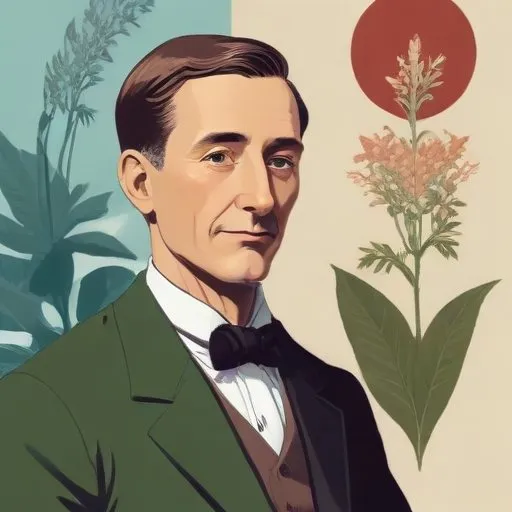
A pioneering botanist who contributed significantly to the discovery and classification of plant species in the Pacific Islands, particularly in Hawaii and Fiji.
Albert Charles Smith, a renowned American botanist, left an indelible mark on the scientific community through his groundbreaking contributions to the field of botany. As the director of the National Museum of Natural History and the Arnold Arboretum, Smith's work spanned across multiple institutions, earning him recognition as a leading authority on Pteridophytes and Spermatophytes.
Born on April 5, 1906, in Springfield, Massachusetts, Smith's fascination with the natural world began at a young age. He pursued his undergraduate degree at Columbia University, graduating in 1926. His academic pursuits continued with a Ph.D. in 1933, which laid the foundation for his illustrious career in botany.
In the late 1920s, Smith embarked on his first tropical expeditions to Colombia, Peru, and Brazil, sparking a lifelong passion for botanical exploration. This journey would later inspire his work as a staff member of the New York Botanical Garden, where he spent several years honing his skills and knowledge.
Smith's leadership roles at the Arnold Arboretum at Harvard and the Smithsonian Institution cemented his status as a respected figure in the scientific community. As the director of the Department of Botany and the National Museum of Natural History, he oversaw significant projects and collaborations, further solidifying his reputation as a visionary in the field.
His contributions didn't stop there. Smith chaired several prestigious scientific societies, including the American Society of Plant Taxonomists, and was elected to the United States National Academy of Sciences in 1963. This distinction acknowledged his tireless efforts to advance our understanding of the plant kingdom.
Smith's work extended far beyond the borders of the United States. He spent time at the University of Hawaii, where he continued to study and teach, and later worked at the National Tropical Botanical Garden. His collaborations also took him to Fiji, where he conducted research and shared his expertise with international colleagues.
Throughout his career, Smith's commitment to the advancement of botanical knowledge has left an enduring legacy. His contributions have inspired generations of scientists, ensuring that his work continues to resonate in the world of botany.
Albert Charles Smith's remarkable life and achievements serve as a testament to the power of dedication and passion. As we reflect on his contributions, we are reminded of the profound impact one individual can have on our understanding of the natural world.
Through his work, Smith has left an indelible mark on the scientific community, inspiring future generations to continue exploring and discovering the wonders of the plant kingdom.
Born in 1810
A pioneering botanist who contributed significantly to the development of American botany, particularly in the fields of plant classification and evolution.
Born in 1851
Pioneering botanist who explored and classified numerous plant species in North America, particularly in the Rocky Mountains, and wrote influential texts on plant morphology and evolution.
