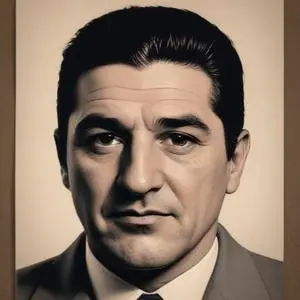
Albert DeSalvo: The Confessed Boston Strangler
A Life of Crime and Controversy
Albert DeSalvo is infamous for confessing to being the Boston Strangler, a serial killer who terrorized Boston, Massachusetts, in the early 1960s, claiming the lives of thirteen women. However, his guilt was disputed due to a lack of physical evidence, and he was only convicted of a series of unrelated rapes.
Early Life: A Troubled Childhood
Born on September 3, 1931, in Chelsea, Massachusetts, DeSalvo grew up in a violent and abusive household. His father, Frank, was an alcoholic who physically abused his wife, Charlotte, and exposed his children to sexual acts with prostitutes. As a child, DeSalvo began torturing animals, a disturbing behavior that would foreshadow his later crimes.
A Life of Crime
DeSalvo's criminal career began at a young age, with his first arrest at 12 years old for battery and robbery. He continued to cross paths with the law, engaging in shoplifting and stealing throughout his adolescence. In 1943, he was sent to the Lyman School for Boys, a juvenile correctional facility.
The Boston Strangler Confession
In 1964, DeSalvo confessed to the Boston Strangler murders while being held at Bridgewater State Hospital for a psychiatric evaluation. His confession included details of the crimes, including the murders of eleven women, but some of the facts he provided were later disputed. Despite his confession, DeSalvo was only convicted of the unrelated rapes and was sentenced to life in prison.
DNA Evidence: The Breakthrough
In 2013, DNA analysis technology advanced enough to re-examine evidence from the Boston Strangler case. Semen found on the body of Mary Sullivan, the last victim, was matched to DNA obtained from DeSalvo's nephew. This breakthrough led to DeSalvo's corpse being exhumed, and his DNA was indeed matched to the crime scene evidence, linking him to Sullivan's murder.
Legacy of Crime and Controversy
DeSalvo's case remains shrouded in controversy, with some continuing to doubt his guilt in the Boston Strangler murders. However, the DNA evidence has strengthened the case against him. DeSalvo's life serves as a cautionary tale of the devastating consequences of childhood trauma and the blurred lines between truth and deception.
Timeline of Key Events
- September 3, 1931: Albert DeSalvo is born in Chelsea, Massachusetts
- 1943: DeSalvo is sent to the Lyman School for Boys
- 1962-1964: The Boston Strangler murders take place
- 1964: DeSalvo confesses to the Boston Strangler murders
- 1967: DeSalvo is convicted of unrelated rapes and sentenced to life in prison
- 1973: DeSalvo dies in prison
- 2013: DNA evidence links DeSalvo to the murder of Mary Sullivan
DeSalvo's story serves as a reminder of the importance of justice, truth, and the pursuit of answers in the face of uncertainty.
FAQ
Who was the Boston Strangler and what were his crimes?
Albert DeSalvo, also known as the Boston Strangler, was an American serial killer responsible for the murders of 11 women in Boston, Massachusetts between 1962 and 1964. His crimes involved breaking into homes, raping, and murdering his victims, mostly elderly women.
How was Albert DeSalvo caught and convicted?
DeSalvo was caught in 1964 after a victim managed to escape and provide a description of her attacker. He was subsequently arrested, confessed to the crimes, and was convicted of the murders. He was sentenced to life imprisonment and died in prison in 1973.
What motivated Albert DeSalvos crimes?
DeSalvos motivations for his crimes are still debated among psychologists and criminologists. Some believe he was driven by a desire for control and power, while others suggest he was motivated by a need for attention and recognition.
What impact did Albert DeSalvos crimes have on society?
DeSalvos crimes led to widespread panic and fear in Boston, and his case remains one of the most infamous in American true crime history. His crimes also led to changes in law enforcement practices, including the development of more sophisticated forensic techniques.
Sub-question: How did Albert DeSalvos crimes impact the families of his victims?
The families of DeSalvos victims were devastated by his crimes, and many suffered long-term emotional trauma as a result. Some families also struggled with feelings of guilt and shame, and many were left with unanswered questions about the motivations behind DeSalvos actions.