


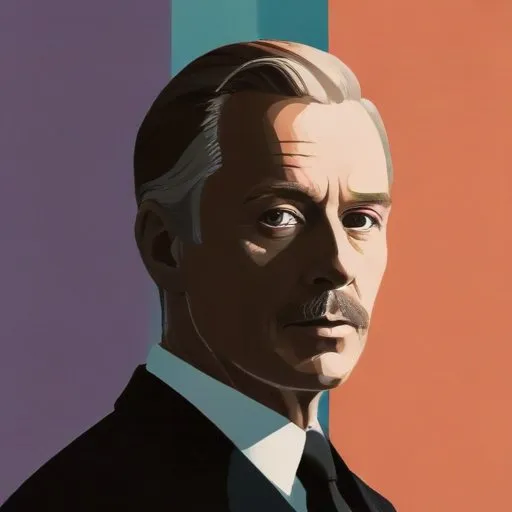
A Swedish actor and director who made significant contributions to the country's early film industry, known for his work in silent films and pioneering efforts in Swedish cinema.
Albert Ranft, a Swedish theatre director and actor, is renowned for his illustrious career that spanned over four decades, leaving an indelible mark on the theatre landscape of Stockholm. As the owner and director of several prominent theatres, Ranft was dubbed the "theatre emperor of Stockholm" in the early 20th century, a testament to his unwavering dedication and contributions to the world of theatre.
Ranft was born on November 23, 1858, in Stockholm, Sweden, to Adolf Fredrik Ranft and Katarina Amalia Reijhell. His brother, Gustaf Adolf Ranft, was also an actor. Ranft's fascination with the stage began at a young age, and he made his debut in 1876 with the theatre company of Danish actress Magda von Dolcke in Örebro.
Throughout the late 19th century, Ranft was involved with various theatre companies, honing his skills as an actor and director. In 1884, he established his own travelling company, which paved the way for his future successes.
Ranft's empire comprised several prominent theatres in Stockholm, including the Vasateatern, the Swedish Theatre, Södra Teatern, and Oscarsteatern. His crowning achievement was the Swedish Theatre, where several seminal plays premiered, including August Strindberg's "A Dream Play" in 1907.
In 1878, Ranft married actress Alma Helin, and later, in 1893, he married actress Lisa Ranft, with whom he had two children, operetta singer Kajsa Ranft and actor Nils Ranft.
Ranft's foray into film resulted in two notable productions: "A Perfect Gentleman" (1927) and "For Her Sake" (1930). He passed away on October 5, 1938, in Stockholm, leaving behind a legacy that continues to inspire and influence the world of theatre.
Ranft's contributions to the world of theatre have had a lasting impact on modern society. His commitment to promoting Swedish theatre and nurturing emerging talent has paved the way for future generations of actors, directors, and playwrights.
Ranft's life and career were deeply rooted in the cultural and historical context of Stockholm during the late 19th and early 20th centuries. His legacy continues to be celebrated and studied, serving as a testament to the power of dedication and passion in the world of theatre.
Ranft's contemporaries, including Hjalmar Selander and August Strindberg, shared his passion for theatre and contributed significantly to the development of Swedish theatre. While they were not identical in their approaches, they collectively enriched the cultural landscape of Stockholm, leaving a lasting impact on the world of theatre.
Albert Ranft's remarkable life and career serve as a testament to the transformative power of dedication and passion. As the "theatre emperor of Stockholm," he left an indelible mark on the world of theatre, inspiring generations to come.
Born in 1915
A legendary actress who captivated audiences with her natural, emotional performances in films like "Casablanca" and "Autumn Sonata", earning her three Academy Awards.
Born in 1905
A legendary actress who captivated audiences with her iconic performances on the silver screen, earning her the title of Hollywood's first female superstar.
Born in 1892
A pioneering filmmaker who charmed audiences with sophisticated comedies and witty romantic dramas, often blending satire and social commentary.
Born in 1873
Pioneering director who revolutionized theater and film with innovative productions, introducing expressionism and avant-garde styles to the masses.
Born in 1886
A Swedish silent film actor, known for his brooding, intense performances in films like "The Saga of Gosta Berling" and "Flesh and the Devil", starring alongside Greta Garbo.
