


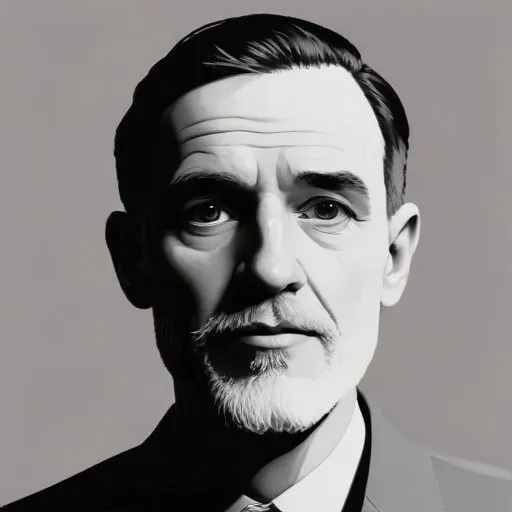
A pioneering Australian artist, he created vivid and emotive works that explored the human condition, often blending realism with surrealist elements. His artwork continues to captivate audiences with its unique blend of beauty and unease.
Albert Tucker, an Australian artist and member of the Heide Circle, is renowned for his modernist and expressionist works that captured the essence of the Great Depression and the turmoil of war.
A self-taught artist, Tucker's early life was marked by hardship and struggle. Born on December 29, 1914, he left school at the age of 14 to support his family and went on to work as a house painter, cartoonist, and commercial illustrator. Despite the lack of formal art training, Tucker's innate talent and dedication led him to attend the Victorian Artists Society evening life drawing class three nights a week for seven years.
Tucker's artistic style was heavily influenced by postimpressionists, expressionists, and social realists. The works of Josl Bergner and Danila Vassilieff, two migrant artists who arrived in Melbourne in the late 1930s, had a profound impact on Tucker's artistic vision.
Tucker's involvement with the Heide Circle, a group of modernist artists and writers, further shaped his artistic identity. The Circle's emphasis on experimental and avant-garde art encouraged Tucker to explore new forms of expression, resulting in some of his most iconic works.
In 1940, Tucker was called up for army service and spent most of his time working in Heidelberg Military Hospital. During this period, he drew patients suffering from wounds and mental illnesses, an experience that greatly influenced his artistic development.
Tucker's wartime experiences led to the creation of some of his most significant works, including Man at Table, a poignant pen and ink illustration of a man whose nose had been sliced off by a shell fragment, and The Waste Land, an image inspired by T.S. Eliot's poem of the same name.
Tucker's association with the Angry Penguins, a group of avant-garde artists and writers, marked a significant turning point in his career. The movement, named after a publication founded by poet Max Harris, sought to challenge traditional artistic norms and promote experimental and modernist art.
Alongside fellow Heide Circle members Sidney Nolan and Arthur Boyd, Tucker's work became synonymous with the Angry Penguins movement, earning him widespread recognition and critical acclaim.
Albert Tucker's contribution to Australian art is undeniable. His pioneering work, characterized by its emotional intensity and expressive power, has inspired generations of artists.
Tucker's legacy extends beyond the artistic sphere, with his war-time experiences and subsequent artwork serving as a powerful reminder of the human cost of conflict.
"Art is a way of understanding, not just a way of expressing."
"The only thing that matters is the work, not the artist."
Tucker was awarded the Wynne Prize in 1957 and was appointed an Officer of the Order of the British Empire in 1974.
Born in 1917
Australian painter famous for his bold, vibrant depictions of Australian landscapes and folklore, particularly his iconic "Ned Kelly" series.
98 Years Old
Australian painter and illustrator renowned for his vibrant, dreamlike depictions of Melbourne streetscapes and iconic characters, particularly Alice in Wonderland. His whimsical style has captivated audiences for generations.
99 Years Old
A pioneering Australian artist celebrated for his vibrant, abstract landscapes that capture the essence of the Australian outback. His unique style blends gestural brushstrokes with bold, earthy tones.
