


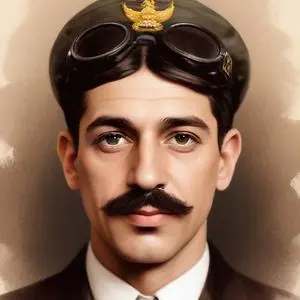
Pioneering aviator credited with inventing and flying the first practical dirigible, and making the first controlled flight in a heavier-than-air aircraft.
Alberto SantosDumont is renowned for his groundbreaking contributions to the development of both lighter-than-air and heavier-than-air aircraft, earning him a coveted spot in the annals of aviation history. This Brazilian aeronaut, inventor, and sportsman is credited with designing, building, and flying the first powered airships, as well as making significant strides in powered heavier-than-air machines.
Born on July 20, 1873, in Brazil, Alberto SantosDumont was the sixth child of Henrique Dumont, an engineer, and Francisca de Paula Santos. He spent most of his adult life in Paris, where he dedicated himself to aeronautical study and experimentation.
SantosDumont's remarkable achievements include winning the Deutsch prize in 1901, when he flew around the Eiffel Tower in his airship No. 6. This feat catapulted him to international fame, making him one of the most celebrated figures of the early 20th century.
In 1906, he made history again by flying the first powered, heavier-than-air aircraft, the 14bis, also known as the "Oiseau de proie" (Bird of Prey). On October 23, he flew 60 meters at a height of two to three meters, and on November 12, he flew an impressive 220 meters at a height of six meters. These flights were certified by the Aeroclub of France, marking the first officially recognized heavier-than-air flights.
In Brazil, Alberto SantosDumont is revered as a national hero, with numerous roads, plazas, schools, monuments, and airports named after him. His name is inscribed on the Tancredo Neves Pantheon of the Fatherland and Freedom, a testament to his enduring impact on the country.
SantosDumont was also a member of the Brazilian Academy of Letters from 1931 until his passing in 1932.
Despite his many achievements, Alberto SantosDumont's life was not without its challenges. He struggled with depression and suffered a tragic loss when his sister, Maria, died in 1918.
In 1931, SantosDumont was elected to the Brazilian Academy of Letters, a significant honor that recognized his literary talents.
Alberto SantosDumont's pioneering work in aviation paved the way for the development of modern air travel, transforming the way people live, work, and communicate. His innovative spirit and perseverance continue to inspire generations of inventors, engineers, and explorers.
In conclusion, Alberto SantosDumont's remarkable life and achievements serve as a testament to the power of human ingenuity, creativity, and determination. His legacy continues to soar, inspiring us to reach new heights and push the boundaries of what is possible.
Born in 1841
A French engineer who designed and built the Ader Avion III, a pioneering aircraft that attempted the first powered, controlled, and sustained flight. He's known for his innovative aviation designs and experiments.
Born in 1872
Pioneering aviator who made the first solo crossing of the English Channel in a heavier-than-air aircraft, achieving a historic milestone in aviation history.
Born in 1838
A German general and entrepreneur who pioneered the development of rigid airships, revolutionizing aviation and transportation in the late 19th and early 20th centuries. He founded a company that bore his name and built iconic airships that dominated the skies.
Born in 1871
Co-founder of the Wright Company, credited with inventing and building the world's first successful airplane, making powered, controlled, and sustained heavier-than-air human flight a reality.
Born in 1867
Designed and built the world's first successful airplane, making the first controlled, powered, and sustained heavier-than-air human flight. This innovation revolutionized transportation and global connectivity.
Born in 1897
Pioneering female aviator who broke records and pushed boundaries in flight, mysteriously disappearing during a attempted circumnavigation of the globe.
Born in 1902
The first person to fly solo non-stop across the Atlantic Ocean, completing a historic 33.5-hour flight in 1927 and becoming an international hero and aviation icon.
Born in 1898
First pilot to fly solo around the world, and developed the first pressure suit, enabling high-altitude flights.
