


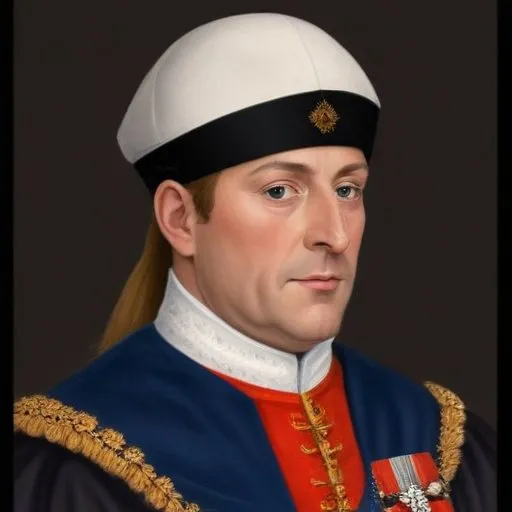
A 15th-century German nobleman who ruled Mecklenburg and was a prominent military leader during the Thirty Years' War. He's remembered for his role in the war and his efforts to maintain Mecklenburg's independence.
Albrecht VII, Duke of Mecklenburg, also known as "the Handsome," was a minor but influential ruler in 16th-century North Germany. He is most notable for his bold claims to Scandinavian thrones, which led to his involvement in the tumultuous Counts' Feud.
Albrecht VII was born on July 25, 1486, in Gstrow, North Germany. On January 17, 1524, he married Anna of Brandenburg, a daughter of Joachim I, Elector of Brandenburg. This union produced 11 children, including future dukes and duchesses of Mecklenburg.
Albrecht VII's most notable achievement was his assertion of claims to Scandinavian thrones, based on the royal lineage of the House of Mecklenburg. He saw an opportunity to expand his territory and influence during the Counts' Feud, a time of great upheaval in the region.
In 1534, the Free City of Lübeck invited Albrecht VII to join their alliance against King Christian III of Denmark. The duke accepted, hoping to gain the Danish crown. However, the alliance ultimately failed, and Albrecht VII, along with Christopher, Count of Oldenburg, was besieged in Copenhagen in 1535-1536 until they capitulated.
Albrecht VII's legacy is marked by his ambition and strategic thinking, even if his plans did not always come to fruition. He was a skilled diplomat and strategist, who navigated the complex web of alliances and rivalries in 16th-century North Germany.
Albrecht VII, Duke of Mecklenburg, may not have achieved his ultimate goal of becoming a Scandinavian monarch, but his influence on North German politics and his legacy as a skilled strategist and diplomat remain significant to this day.
Born in 1479
Ruler of Mecklenburg from 1503 to 1552, known for his role in the Protestant Reformation and his attempts to unify the German states.
Born in 1479
Ruler of Mecklenburg from 1503 to 1552, known for his role in the Protestant Reformation and his attempts to unify the German states.
