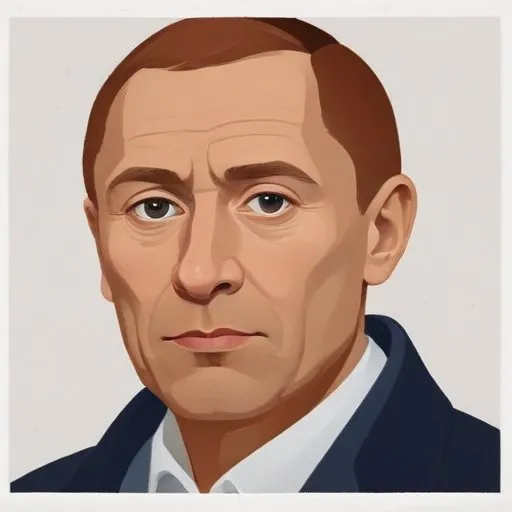
Aleksandr Deyneka

Aleksandr Deyneka

Aleksandr Deyneka was born on May 20th, 1899

Full Name: Aleksandr Aleksandrovich Deyneka
Nationality: Russian
Occupation: Painter and sculptor
Style: Socialist realism
Birth Date: 1899
Death Date: 1969
Notable Work: Defense of Petrograd
Education: VKhUTEMAS

A pioneering artist of the Soviet era, celebrated for vibrant, dynamic depictions of industrial and athletic scenes, blending realism with futurist elements.

Written by: Emily Carter Emily Carter

Aleksandr Deyneka: The Soviet Russian Master of Modernist Figurative Painting

Aleksandr Deyneka, a prominent Soviet Russian painter, graphic artist, and sculptor, is renowned for his iconic works that epitomize the socialist realist style. His masterpiece, "Collective Farmer on a Bicycle" (1935), is a testament to his skill in capturing the essence of modernist figurative painting.

Early Life and Education

Born on May 20, 1899, in Kursk, Russia, Deyneka's artistic journey began at a young age. He studied at Kharkov Art College under the tutelage of Alexander Lubimov and later at VKhUTEMAS, where he honed his craft.

Artistic Career and Contributions

Deyneka's work gained widespread recognition through his involvement with prominent art groups such as OST and Oktyabr. His paintings and drawings, often monotone due to the scarcity of art supplies, depicted genre scenes, labor, and sports. As his career progressed, he shifted his focus to monumental works, including "The Defense of Petrograd" (1928), "The Battle of Sevastopol" (1942), and "The Outskirts of Moscow. November 1941."

Mosaics and Metro Station Masterpiece

Deyneka's mosaic creations adorn the Mayakovskaya metro station in Moscow, a testament to his versatility as an artist. His work continues to inspire and influence generations of artists.

Honors and Awards

Aleksandr Deyneka's contributions to the art world were recognized with numerous honors, including:

Legacy and Impact

Deyneka's legacy extends beyond his artwork. His philosophy, captured in the title of one of his works, "Work, Build, and Don't Whine," is a testament to his dedication to his craft. A 2016 exhibition at London's Gallery for Russian Arts and Design, titled after his work, celebrated the spirit of socialist realist art.

Personal Milestone and Key Life Events

Aleksandr Deyneka's life was marked by significant milestones, including his burial in the esteemed Novodevichy Cemetery in Moscow.

Influence on Modern Society and Pop Culture

Deyneka's oeuvre continues to inspire artists, with his work influencing modern society and pop culture. His dedication to his craft serves as a motivation to aspiring artists, encouraging them to strive for excellence.

Trivia and Fun Facts

Did you know that Aleksandr Deyneka is categorized as a world-famous artist in the United Art Rating, with a ranking of 1A?

Through his remarkable body of work, Aleksandr Deyneka has left an indelible mark on the world of modernist figurative painting. His legacy serves as a testament to the power of art to inspire and educate, continuing to captivate audiences to this day.

Timeline
1899
Birth in Kursk, Russia
Aleksandr Deyneka was born on May 20, 1899, in Kursk, Russia. He would go on to become a renowned Russian painter and sculptor.
1920
Studies Art in Moscow
Deyneka studied art in Moscow from 1920 to 1925, where he was influenced by Constructivism and Futurism.
1930
Becomes Member of Artists Union of the USSR
Deyneka became a member of the Artists Union of the USSR in 1930, solidifying his position in the Soviet art scene.
1945
Participates in Soviet War Effort
Deyneka participated in the Soviet war effort during World War II, creating propaganda posters and artwork.
1969
Death in Moscow, Russia
Aleksandr Deyneka passed away on June 12, 1969, in Moscow, Russia, leaving behind a legacy as a prominent Russian artist.
Aleksandr Deyneka

Aleksandr Deyneka Quiz

Aleksandr Deyneka's artwork often blended realism with what other style?

Score: 0/5
FAQ
What style of art did Aleksandr Deyneka pioneer in Russia?
Aleksandr Deyneka was a prominent figure in the development of Socialist Realism in Russian art, characterized by propagandist and heroic depictions of Soviet life. His work often featured bold colors and dynamic compositions, capturing the spirit of the Soviet era.
What is Aleksandr Deynekas most famous artwork?
One of Aleksandr Deynekas most notable works is Defense of Petrograd (1928), a large-scale painting that depicts the defense of Petrograd during the Russian Civil War. The artwork showcases his mastery of color and composition, and is considered a classic of Soviet art.
When did Aleksandr Deyneka start his artistic career?
Aleksandr Deyneka began his artistic career in the 1920s, studying at the VkhuTeMas art school in Moscow. During this period, he was heavily influenced by the works of Russian avant-garde artists such as Kazimir Malevich and Vladimir Tatlin.
What awards did Aleksandr Deyneka receive for his contributions to Russian art?
Aleksandr Deyneka was awarded several prestigious awards for his contributions to Russian art, including the Stalin Prize in 1943 and the title of Peoples Artist of the USSR in 1963.
How did Aleksandr Deynekas work impact the development of Soviet art?
Aleksandr Deynekas work played a significant role in shaping the style and direction of Soviet art, inspiring a generation of artists to create works that celebrated the ideals of socialism and communism. His influence can be seen in the work of many prominent Soviet artists, including Nikolai Romadin and Mikhail Khmelko.