


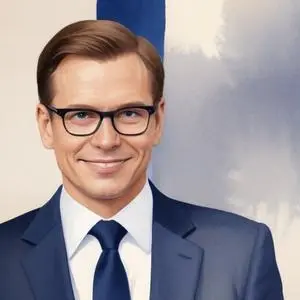
Finnish politician who served as Prime Minister and President, known for his strong advocacy for European integration and economic reforms.
Alexander Stubb is a Finnish politician who has made a significant impact on the country's politics and beyond. Currently serving as the 13th President of Finland since 1 March 2024, Stubb has had an illustrious career spanning over two decades.
Stubb's rise to prominence began as a researcher specialized in European Union affairs. His expertise led him to be elected to the European Parliament in 2004 as a member of the National Coalition Party. This marked the beginning of his political journey, which would take him to the highest echelons of Finnish politics.
As Prime Minister, Stubb demonstrated his leadership skills by forming a five-party government coalition. His vision for Finland's growth and development was evident in his policies, which aimed to strengthen the country's economy and reputation in the European Union.
Stubb is known for his strong advocacy for European integration and his commitment to liberal democracy. He believes in the importance of collaboration and cooperation between nations to address global challenges.
Stubb's leadership and vision have had a profound impact on modern Finnish society. His commitment to European integration and liberal democracy has inspired a new generation of politicians and citizens alike.
Stubb's leadership has not been without controversy. He faced challenges from within his party, and his leadership was eventually contested by MP Elina Lepomäki and Interior Minister Petteri Orpo. However, his dedication to public service and his vision for Finland's future have earned him widespread respect.
As the 13th President of Finland, Stubb's legacy is only just beginning to unfold. His leadership and vision are expected to have a lasting impact on Finnish politics and diplomacy, and his commitment to European integration will continue to shape the country's relationships with its neighbors and the world.
72 Years Old
The first female Chancellor of Germany, serving for 16 years, known for her leadership during the European sovereign-debt crisis and her role in shaping the European Union's policy. She's a highly influential figure in modern politics.
71 Years Old
Luxembourg's Prime Minister from 1995 to 2013, known for his key role in shaping the European Union's economic and monetary policies. He was the President of the European Commission from 2014 to 2019, overseeing the EU's executive body.
69 Years Old
The 14th Prime Minister of Poland, a journalist-turned-politician who played a key role in shaping the country's post-communist era and later became a prominent EU leader. He's known for his strong stance on European integration and criticism of authoritarianism.
78 Years Old
The first permanent President of the European Council, known for his role in shaping the European Union's economic and political policies. A key figure in European politics, guiding the EU through the European sovereign-debt crisis.
61 Years Old
The 42nd Prime Minister of Sweden, serving from 2006 to 2014, known for leading a center-right government and implementing significant reforms in taxation and labor market policies.
73 Years Old
The 39th Prime Minister of Denmark, a strong advocate for European integration and NATO's 12th Secretary-General, known for his efforts to strengthen transatlantic relations.
70 Years Old
The first Prime Minister of Portugal to serve two consecutive terms, known for his efforts to reform the country's economy and his later role as President of the European Commission.
