


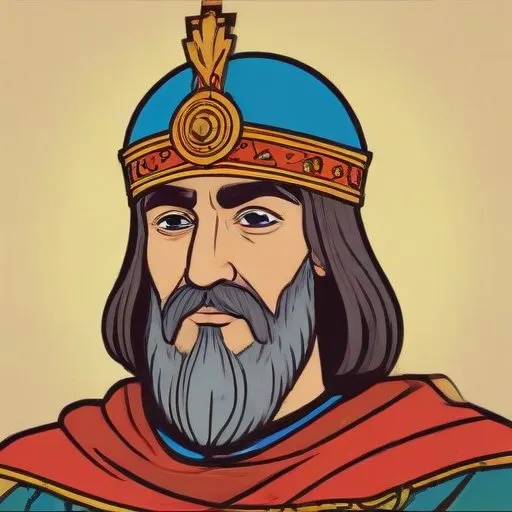
Emperor of the Trapezuntine Empire from 1349 to 1390, known for his diplomatic and military efforts to maintain independence from the Ottoman Empire.
Imagine an emperor so revered that his reign is remembered for centuries, marked by a plethora of literary creations and religious grants that shaped the fabric of Trebizond's society. This is the essence of Alexios III of Trebizond, a man whose legacy continues to fascinate historians and scholars to this day.
Born John, Ianns, on October 5, 1338, Alexios III was the son of Emperor Basil of Trebizond and his second wife, Irene of Trebizond. Interestingly, he took the name Alexios in memory of his older brother who had died prematurely or in honor of his paternal grandfather, Emperor Alexios II of Trebizond.
Contemporary accounts describe Alexios III as a man of noble appearance, with a florid complexion, blonde hair, and regular features. His aquiline nose, reminiscent of a royal feature as noted by Plato, added to his regal bearing. Physically, he was stout and well-formed, with a strong presence that commanded respect.
Following the death of his father, Basil, on April 6, 1340, Alexios III's mother, Irene Palaiologina, succeeded him, only to be eventually deposed by Emperor John VI Kantakouzenos. The young Alexios was sent to Constantinople, where he was raised at the Byzantine court. At the tender age of eleven, he was dispatched to Trebizond to replace his deposed great-uncle Michael, marking the beginning of his remarkable reign.
Upon his arrival in Trebizond on December 22, 1349, Alexios III was welcomed by the nobility, led by megas doux Niketas Scholares, who recognized him as the rightful emperor without opposition. His coronation took place on January 21, 1350, in the presence of his mother and John Lazaropoulos, solidifying his position as the ruler of Trebizond.
Alexios III's reign is distinguished by a profusion of literary creations and religious grants that have left an indelible mark on Trebizond's history. His patronage of scholars and writers led to the creation of numerous works of literature, showcasing the rich cultural heritage of the empire.
Moreover, Alexios III's religious grants demonstrate his commitment to the Orthodox Church, which played a vital role in the spiritual lives of his subjects. His reign was marked by a period of relative stability, allowing the empire to flourish under his wise leadership.
Alexios III's legacy extends far beyond his impressive literary and religious achievements. His reign marked a period of significant cultural and intellectual growth, shaping the very fabric of Trebizond's society. As one of the most well-documented rulers of the empire, his impact on modern society is a testament to his enduring influence.
As we delve into the life and reign of Alexios III, we are reminded of the power of visionary leadership, cultural patronage, and religious devotion. His story serves as a beacon, inspiring future generations to strive for greatness and leave a lasting legacy.
Born in 1364
Last emperor of the Byzantine Empire's Trebizond branch, ruling from 1390 to 1417, known for his diplomatic efforts to unite the fragmented empire against the Ottoman threat.
Born in 1395
A renowned Greek philosopher, scholar, and humanist who translated Aristotle's works into Latin, making them accessible to Western scholars, and wrote influential commentaries on classical texts.
