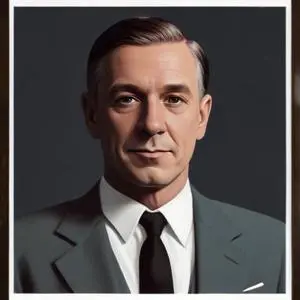
Alfred P. Sloan: The Visionary Who Revved Up General Motors
The Architect of Automotive Industry Transformation
Alfred P. Sloan Jr. is widely recognized as one of the most influential figures in the history of the automotive industry. As the longtime president, chairman, and CEO of General Motors Corporation, Sloan played a pivotal role in transforming the company into a global powerhouse, making it the largest and most profitable automobile manufacturer in the world.
Early Life and Education
Born on May 23, 1875, in New Haven, Connecticut, Sloan's fascination with machines and technology began at an early age. He studied electrical engineering at Brooklyn Polytechnic Institute before transferring to the Massachusetts Institute of Technology (MIT), where he graduated in 1895. During his time at MIT, Sloan joined the Delta Upsilon fraternity and developed a lifelong passion for engineering and innovation.
Rise to Prominence
In 1898, Sloan married Irene Jackson of Roxbury, Massachusetts, and began his career as the president and owner of Hyatt Roller Bearing, a company that produced high-quality bearings for the automotive industry. His innovative approach and commitment to excellence soon made Hyatt a preferred supplier to leading car manufacturers, including Oldsmobile and Henry Leland's Cadillac.
General Motors: The Sloan Era
In 1920, Sloan joined General Motors as a senior executive, bringing with him his expertise in engineering, manufacturing, and marketing. Over the next four decades, Sloan's vision, leadership, and strategic thinking transformed GM into a behemoth, with a diverse portfolio of brands, including Chevrolet, Buick, and Cadillac. Under his guidance, GM pioneered concepts such as the annual model change, brand architecture, industrial engineering, automotive design styling, and planned obsolescence, revolutionizing the industry and reshaping American culture.
A Philanthropist and Memoirist
Sloan was not only a shrewd businessman but also a dedicated philanthropist. He supported various educational institutions, including MIT, and was a generous contributor to the Sloan-Kettering Institute for Cancer Research. In the 1950s, Sloan penned his memoir,
My Years with General Motors, offering valuable insights into his life, career, and the evolution of the automotive industry.
Legacy and Controversy
Sloan's legacy is complex, with both admirers and critics acknowledging his remarkable achievements. While he is remembered for his philanthropy and business acumen, some have raised concerns about his views during the interwar period and World War II. Nevertheless, Sloan's impact on the automotive industry, American culture, and the global economy is undeniable, cementing his place as one of the most influential business leaders of the 20th century.
Personal Milestones and Key Life Events
- May 23, 1875: Born in New Haven, Connecticut
- 1895: Graduated from the Massachusetts Institute of Technology
- 1898: Married Irene Jackson of Roxbury, Massachusetts
- 1899: Became president and owner of Hyatt Roller Bearing
- 1920: Joined General Motors as a senior executive
- 1946: Became CEO of General Motors
- 1950s: Wrote his memoir, My Years with General Motors
- February 17, 1966: Passed away at the age of 90
Trivia and Fun Facts
- Sloan was known for his love of classical music and was an accomplished violinist.
- He was a strong supporter of the Ford Motor Company's efforts during World War II.
- Sloan's salary was a modest $15,000 in 1920, equivalent to approximately $225,000 today.
Awards and Honors
- Received the honorary degree of Doctor of Engineering from MIT in 1933
- Awarded the Medal for Merit in 1946 for his contributions to the war effort
Historical Context and Legacy
Alfred P. Sloan Jr.'s life and career spanned a transformative period in American history, marked by rapid industrialization, technological innovation, and shifting social norms. As a visionary leader, Sloan played a significant role in shaping the automotive industry, redefining corporate culture, and leaving an indelible mark on modern society.
FAQ
What company did Alfred P. Sloan Jr. lead?
Alfred P. Sloan Jr. was the CEO of General Motors (GM) from 1923 to 1947, a period of significant growth and innovation for the company.
What innovations did Alfred P. Sloan Jr. introduce at GM?
Alfred P. Sloan Jr. introduced various innovations at GM, including the development of the annual model change, which revolutionized the automotive industry.
What philanthropic efforts did Alfred P. Sloan Jr. support?
Alfred P. Sloan Jr. was a generous philanthropist who supported various causes, including the establishment of the Alfred P. Sloan Foundation, which focuses on education and scientific research.
Did Alfred P. Sloan Jr. receive any awards for his work?
Yes, Alfred P. Sloan Jr. received numerous awards for his contributions to the automotive industry, including the Presidential Medal of Freedom in 1964.
What was Alfred P. Sloan Jr.s management style?
Alfred P. Sloan Jr. was known for his decentralized management style, which gave GMs divisions a high degree of autonomy and encouraged innovation and competition.