


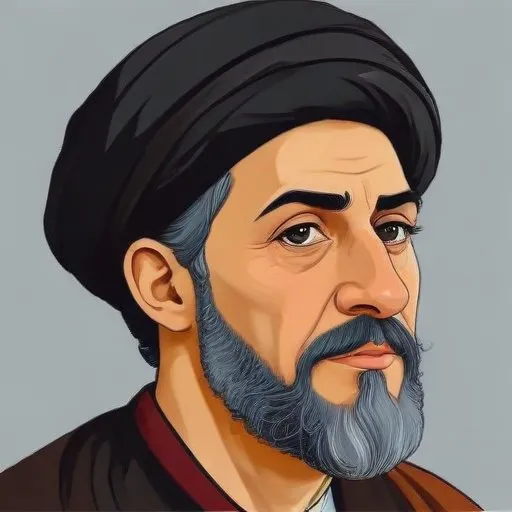
A renowned sculptor and educator who merged Eastern and Western artistic styles, creating thought-provoking installations that explored cultural identity and social justice.
Ali Hadi Bara was a renowned Turkish sculptor, celebrated as one of the first artists of the Republican generation in Turkey. Known for his iconic monuments and sculptures, Bara's works continue to adorn the Turkish landscape, paying tribute to the nation's rich history and cultural heritage.
Born on September 9, 1906, in Tehran, Iran, Bara moved to the Ottoman Empire with his family at a young age. He pursued his passion for art at the Fine Arts Academy in Istanbul, where he studied from 1923 to 1927. His artistic journey continued in Paris, where he honed his skills in sculpture under the guidance of esteemed artists Henri Bouchard and Charles Despiau.
Upon his return to Istanbul in 1930, Bara became an assistant teacher at the Fine Arts Academy. This marked the beginning of his illustrious career, as he started creating sculptures that would soon become synonymous with Turkish culture. His breakthrough work, the Adana Monument (1935), catapulted him to fame, followed by the Monument to Atatürk (1937) and the iconic Statue of Barbarossa (1946) in Beiktaş, Istanbul.
In the late 1940s, Bara's artistic style underwent a significant transformation. He shifted his focus from figurative to non-figurative sculpture, exploring new forms and techniques. This creative evolution led to the development of a unique style that blended traditional Turkish motifs with modernist sensibilities.
Bara's contributions to Turkish art were recognized on the global stage, as he participated in prestigious international exhibitions. His works were showcased at the Venice Biennale (1956, 1958), São Paulo Biennial (1957, 1961), and the Exposition Internationale de Sculpture Contemporaine at the Musée Rodin, Paris (1961).
Ali Hadi Bara's sculptures have become an integral part of Turkey's cultural landscape. His works not only pay tribute to the nation's history but also contribute to the country's identity. Through his art, Bara has inspired generations of Turkish artists, cementing his position as a pioneer in Turkish sculpture.
Ali Hadi Bara passed away on August 30, 1971, leaving behind a legacy that continues to inspire and influence Turkish art. His remarkable journey, from a young artist to a national icon, serves as a testament to his dedication to his craft and his country.
Born in 1840
A Turkish journalist, playwright, and activist who championed liberal reforms and Turkish nationalism through his writings, inspiring a generation of Ottoman intellectuals.
