


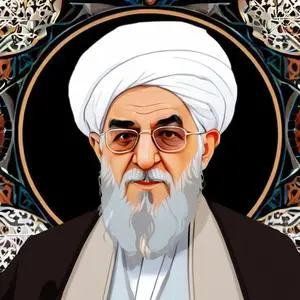
The current Supreme Leader of Iran, who has been in power since 1989, is known for his conservative and anti-Western views, and for holding significant influence over the country's political and religious affairs.
Ali Khamenei, born on April 19, 1939, is the Supreme Leader of Iran, a position he has held since 1989, making him the longest-serving head of state in the Middle East. As a prominent Twelver Shia marja and politician, he has played a pivotal role in shaping Iran's political landscape, earning him a reputation as a shrewd politician and a fierce protector of the Islamic Republic.
Khamenei's early life was marked by his fervent opposition to the Pahlavi monarchy, which led to his arrest six times and eventual exile for three years. During his exile, he continued to advocate for the overthrow of the monarchy, which finally came to pass in 1979 with the Iranian Revolution.
Khamenei's rise to power began in 1981, when he was elected as the third President of Iran. He served in this position until 1989, during which he formed close ties with the Revolutionary Guards and became a trusted ally of the first Supreme Leader, Ruhollah Khomeini. Following Khomeini's death, Khamenei was elected as the next Supreme Leader by the Assembly of Experts, a position he has held for over three decades.
As Supreme Leader, Khamenei has wielded significant power, appointing and dismissing commanders of the Revolutionary Guards, making decisions on key government policies, and exercising control over the country's judiciary and media. His leadership has been marked by controversies, including the suppression of opposition movements and the deployment of the Revolutionary Guards to quell dissent.
Khamenei is known for his conservative and anti-Western stance, emphasizing the importance of Islamic values and the need for Iran to maintain its independence from foreign influence. He has also been a vocal critic of the United States, which he views as a threat to Iran's sovereignty.
Khamenei's leadership has had a profound impact on modern Iranian society, shaping the country's politics, economy, and culture. He has been instrumental in promoting the development of Iran's nuclear program and has played a key role in shaping the country's foreign policy.
"The Islamic Republic of Iran is not just a political entity, it is a ideology, a way of life."
"We will not compromise on our principles, even if it means facing sanctions and isolation."
Khamenei's enduring leadership has cemented his place in Iranian history, alongside other prominent figures such as Ruhollah Khomeini and Mohammad Reza Pahlavi. His legacy will be shaped by his commitment to preserving the Islamic Republic and his ability to navigate the complexities of regional and global politics.
As the longest-serving head of state in the Middle East, Khamenei's influence extends far beyond Iran's borders, making him a key player in shaping the region's political landscape. His life and legacy serve as a testament to the power of conviction and the enduring appeal of Islamic values in modern times.
69 Years Old
Iran's sixth president, a controversial figure known for his anti-Western rhetoric and disputed re-election, who sparked global concern over Iran's nuclear program.
77 Years Old
The 7th President of Iran, a moderate reformist who advocated for nuclear diplomacy and economic reform, known for his efforts to improve relations with the West.
83 Years Old
The 5th President of Iran, a reformist who advocated for democracy, human rights, and dialogue between civilizations, is known for his efforts to liberalize Iran's political and social landscape. He's also a prominent scholar and writer.
84 Years Old
Iran's 79th Prime Minister and a key figure in the 2009 Green Movement, known for his reformist policies and opposition to the country's authoritarian regime. He's a prominent advocate for democracy and human rights in Iran.
