


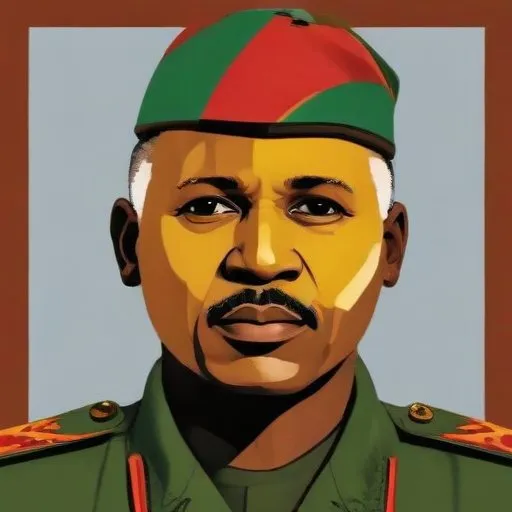
A Malian soldier-turned-politician who served as President of Mali from 2002 to 2012, known for his role in democratizing the country and promoting regional stability.
Amadou Toumani Tour, a stalwart of Malian politics, is renowned for supervising the country's first multiparty elections as chairman of the transitional government from 1991 to 1992, and later becoming the second democratically elected President of Mali from 2002 to 2012. His leadership played a pivotal role in shaping Mali's democratic landscape, ushering in a new era of multiparty politics and civilian rule.
Born on November 4, 1948, in Mopti, Mali, Tour attended primary school in his hometown before moving on to Badalabougou Standard Secondary School in Bamako. He eventually joined the army and attended the Kati Inter-Military College, rising through the ranks to become the commander of the parachute commandos in 1984.
In March 1991, a popular revolution against 23 years of military rule forced President Moussa Traoré to step down. As head of the President's personal guard and parachute regiment, Tour arrested the President and led the revolution onwards. He then presided over a year-long military-civilian transition process, which produced a new Constitution and multiparty elections. This transition period culminated in the election of Alpha Oumar Konaré as Mali's first democratically elected President on June 6, 1992.
Tour entered politics as a civilian in 2002, winning the presidential election with a broad coalition of support. He was re-elected in 2007 to a second and final term, earning praise for his commitment to democratic reforms and economic development. During his tenure, he implemented various projects aimed at improving infrastructure, healthcare, and education, cementing his place as a champion of Malian democracy.
On March 22, 2012, a military coup forced Tour into hiding, just before his scheduled departure from office. As part of an agreement to restore constitutional order, he resigned from the presidency on April 8 and went into exile eleven days later.
Tour's leadership philosophy was rooted in a commitment to democratic values, human rights, and social justice. He believed in the importance of civilian rule, multiparty politics, and the separation of powers. His presidency was marked by efforts to promote national reconciliation, social cohesion, and economic development.
Amadou Toumani Tour's legacy as a champion of democratic transition and civilian rule continues to inspire generations of Malians and Africans. His commitment to democracy, human rights, and social justice serves as a beacon of hope for a continent grappling with the challenges of political instability and authoritarianism.
80 Years Old
A Malian academic and politician who served as the 3rd President of Mali, known for his efforts to establish democracy and promote economic development in the country. He's also a respected historian and writer.
81 Years Old
A Malian academic and politician who served as Prime Minister of Mali, known for his efforts to stabilize the country and promote economic development. He played a key role in Mali's transition to democracy.
89 Years Old
A Malian general and politician who seized power in a 1968 coup and ruled Mali for 23 years, known for his authoritarian regime and human rights abuses.
Born in 1915
First President of Mali, leading the country to independence from France in 1960 and implementing socialist policies. Known for his efforts to modernize and unify the country.
76 Years Old
A Malian engineer and politician who played a crucial role in developing his country's infrastructure and served as the Minister of Mines and Energy, known for his efforts to modernize Mali's energy sector.
