


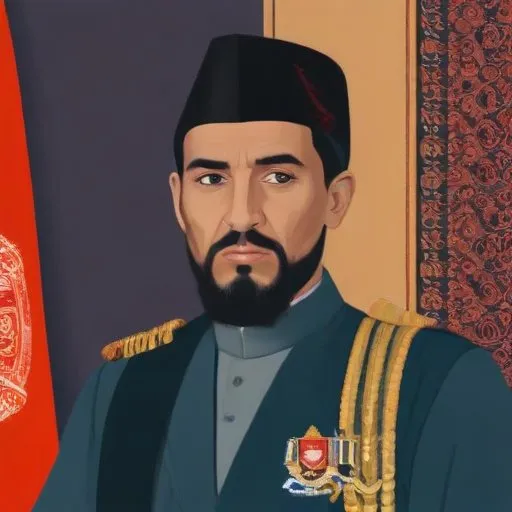
Reformer and modernizer who introduced Western-style reforms and gained independence from British colonial rule, transforming Afghanistan into a modern nation-state.
Amanullah Khan, born on June 1, 1892, was the sovereign of Afghanistan from 1919 to 1929, first as Emir and later as King. He is renowned for proclaiming Afghanistan's independence from British influence and pursuing a path of modernization, which was unprecedented in the country's history.
Amanullah Khan was born in Paghman, near Kabul, Afghanistan, to a Pashtun family. He was the third son of Emir Habibullah Khan and was favored by his father. After his father's assassination in 1919, Amanullah was installed as the governor of Kabul, controlling the army and the treasury. He gained the allegiance of most tribal leaders, paving the way for his rise to power.
Amanullah Khan's most significant achievement was Afghanistan's proclamation of independence from British influence in 1919, following the end of the Third Anglo-Afghan War. He pursued a path of modernization, introducing reforms to bring Afghanistan in line with Western standards. His vision was to create a modern, secular state, with equal rights for women and men.
Amanullah Khan's reforms were met with resistance from traditionalist and Islamist groups, who saw his modernization efforts as a threat to Islamic values. In 1929, an uprising led by Habibullah Kalakani forced Amanullah to abdicate and flee to British India. From there, he went into exile in Europe, where he spent the next 30 years.
Amanullah Khan's legacy is complex and multifaceted. While his modernization efforts were ahead of their time, they ultimately led to his downfall. However, he is remembered as a visionary leader who dared to challenge traditional norms and pursue a path of progress and development. He died on April 26, 1960, in Zurich, Switzerland, and was buried in Jalalabad, near his father's tomb.
"I want to make my country a truly independent and free nation, where every Afghan can live with dignity and self-respect."
Amanullah Khan's story serves as an inspiration to leaders and reformers around the world, who dare to challenge the status quo and pursue a path of progress and development. His legacy continues to shape Afghanistan's destiny, and his vision for a modern, secular state remains an aspiration for the country's people.
59 Years Old
A British journalist and explorer who wrote about his thrilling adventures and encounters with mystics, warlords, and other fascinating characters in exotic locations. His travelogues are infused with humor, curiosity, and a sense of wonder.
Born in 1909
The first president of Afghanistan, who ruled from 1973 to 1978, is known for his modernization efforts and attempts to reduce the country's dependence on foreign powers. He's also infamous for his brutal suppression of opposition and eventual assassination.
Born in 1914
The last king of Afghanistan, ruling from 1933 to 1973, known for modernizing and stabilizing the country, and later being exiled and returning after the fall of the Taliban.
