


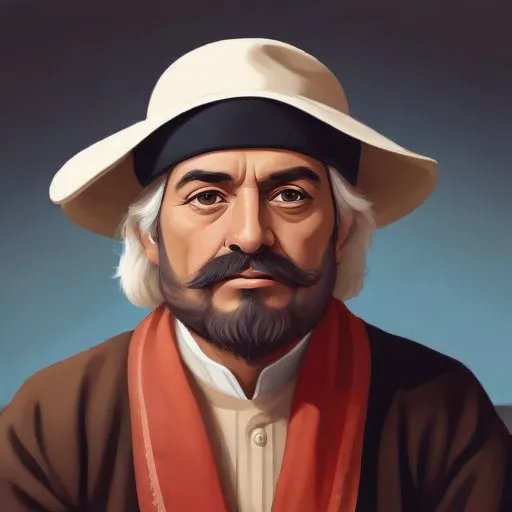
A 16th-century Maltese trader and explorer who traveled extensively throughout the Mediterranean, documenting his journeys and providing valuable insights into the region's history and culture.
Andrea Debono, also known as Latif Effendi, was a trailblazing Maltese trader and explorer who ventured into the uncharted territories of the White Nile in the mid-19th century, becoming one of the first Europeans to do so. His courageous expeditions and meticulous documentation of the region's geography and cultures have left an indelible mark on the world of exploration and cartography.
Born on November 7, 1821, in Senglea, Malta, Debono was the son of Michael Debono, a captain of the merchant navy, and his wife Teresa nee Carabott. He had a twin sister, Battistina, and received a well-rounded education in medicine and chemistry during his youth.
The Debono family's emigration to Alexandria, Egypt, marked the beginning of Andrea's African odyssey. He worked in a hospital in Alexandria before moving to Cairo, where he lived with his sister after their parents' passing. The Sudanese city of Khartoum became his next destination in 1848, where he built a corn mill and established himself in the production of building materials.
In Khartoum, Debono married Victoria, an Abyssinian woman, and they had three children, although two of them sadly passed away in infancy. This period also marked a significant change in Debono's identity, as he adopted the name Latif Effendi and began serving the Egyptian Governor of Sudan in 1851.
Debono's involvement in the ivory trade brought him significant profits, and he employed around 400 men as porters or boatmen. This period also saw him embark on a series of expeditions, during which he became the first European to explore the Sobat River tributary of the White Nile, venturing as far as the cataracts beyond Gondokoro.
In 1854-1855, Debono undertook a perilous 300-mile journey to the mouth of the Sobat, accompanied by his wife, son, and agent Philippe Terranuova. The journey was fraught with challenges, including a six-month grounding of their boats due to the dry season and threats from hostile natives.
Between 1855 and 1856, Debono served as the British Consular Agent in Khartoum, further solidifying his reputation as a respected figure in the region. In 1859, he once again explored Gondokoro, and three years later, he published a book detailing his travels and experiences.
Although Debono's contributions to the world of exploration and geography are undeniable, his methods and actions have been criticized by some, including the British explorer Samuel Baker, who described Debono's people as "the worst of the lot, having utterly destroyed the country."
Andrea Debono's remarkable life and achievements have left an indelible mark on the history of exploration and cartography. His bravery, determination, and scientific contributions have inspired generations of explorers, and his legacy continues to fascinate and educate people around the world.
