


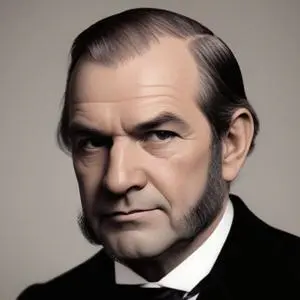
The 17th President of the United States, a southern Democrat who became president after Lincoln's assassination, is known for his role in Reconstruction and his impeachment trial. He's infamous for his lenient policies towards former Confederates and his vetoes of civil rights legislation.
Andrew Johnson is best known for being the 17th President of the United States, serving from 1865 to 1869, and for being the first president to be impeached by the House of Representatives. He assumed the presidency after the assassination of Abraham Lincoln, with whom he had run on the National Union Party ticket.
Andrew Johnson was born on December 29, 1808, in Raleigh, North Carolina, to Jacob and Mary Johnson. Growing up in poverty, Johnson never had the opportunity to attend school. Instead, he was apprenticed as a tailor and eventually opened his own tailor shop in Greeneville, Tennessee.
In addition to his work as a tailor, Johnson became involved in politics, serving as an alderman, mayor, and member of the Tennessee House of Representatives. He was elected to the Tennessee Senate in 1841 and later served five terms in the U.S. House of Representatives.
Johnson's political career continued to flourish when he was elected governor of Tennessee in 1853. He went on to serve in the U.S. Senate from 1857 to 1862, where he championed the Homestead Bill, which was eventually passed in 1862.
During the American Civil War, Johnson remained loyal to the Union, even when his home state of Tennessee seceded from the Union. This loyalty caught the attention of President Abraham Lincoln, who appointed Johnson as the Military Governor of Tennessee in 1862.
Johnson's loyalty and political prowess made him a logical choice as Lincoln's running mate in the 1864 election. The ticket won, and Johnson became Vice President of the United States.
After Lincoln's assassination, Johnson became the 17th President of the United States. His presidency was marked by controversy, particularly with regard to Reconstruction and the rights of former slaves.
Johnson's lenient Reconstruction policies, which favored quick readmission of Southern states to the Union without ensuring the rights of freed slaves, led to conflict with the Republican-dominated Congress. This conflict ultimately resulted in his impeachment by the House of Representatives in 1868.
Johnson was acquitted by a single vote in the Senate, avoiding removal from office. However, his presidency was marked by controversy, and his legacy continues to be debated among historians and scholars.
Andrew Johnson married Eliza McCardle in 1827, and the couple had five children together. He died on July 31, 1875, at the age of 66, and was buried in Greeneville, Tennessee.
Johnson's legacy is complex and multifaceted. While he was a strong supporter of the Union during the Civil War, his presidency was marked by controversy and a lack of progress on civil rights. Nevertheless, his commitment to the principles of democracy and his role in shaping the Reconstruction era continue to influence American politics to this day.
Andrew Johnson's life and legacy serve as a reminder of the complexities and challenges of American history. Despite his flaws and controversies, he played a significant role in shaping the nation during a tumultuous era.
Born in 1809
Led the United States through its Civil War and ultimately abolished slavery, leaving a lasting legacy in American history.
Born in 1822
Led the Union Army to victory in the Civil War and later became President, known for issuing the Emancipation Proclamation and strengthening federal authority.
Born in 1807
Led the Confederate States Army during the American Civil War, surrendering to Union forces at Appomattox, marking the war's effective end.
Born in 1808
The President of the Confederate States of America during the American Civil War, leading the secessionist movement and fighting to preserve slavery. He's infamous for his role in the Civil War and its aftermath.
Born in 1808
The 6th Chief Justice of the United States, a strong advocate for slavery abolition and a key player in shaping the country's financial system, particularly during the Civil War era.
Born in 1801
The 24th United States Secretary of State played a crucial role in shaping America's foreign policy, particularly in the acquisition of Alaska from Russia in 1867. He's also known for his strong anti-slavery stance.
