


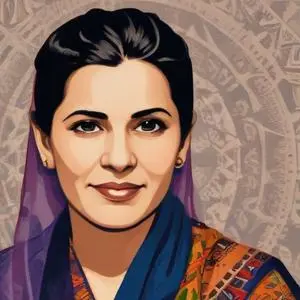
A pioneering figure in women's rights and Indian independence, known for her tireless advocacy and influential writings that inspired generations of activists and thinkers.
Annie Besant was a British socialist, theosophist, freemason, and women's rights activist who left an indelible mark on the world through her tireless crusade for social justice, education, and spiritual enlightenment. As the first female president of the Indian National Congress, she championed the cause of Indian nationalism and self-rule, earning her a revered place in the annals of Indian history.
Born on October 1, 1847, in London, England, Besant was drawn to social activism from a young age. She became a vocal advocate for women's rights, education, and better living conditions for the poor. Her involvement with the National Secular Society (NSS) and her close friendship with Charles Bradlaugh, a prominent secularist, further solidified her commitment to social reform.
In 1890, Besant's life took a dramatic turn when she met Helena Blavatsky, co-founder of the Theosophical Society. Over the next few years, her interest in theosophy grew, and she became a prominent lecturer on the subject. This marked a significant shift in her focus from secular matters to spiritual and philosophical pursuits.
Besant's involvement with the Theosophical Society led to a deep exploration of Eastern philosophy, mysticism, and spiritualism. She became a leading exponent of theosophical thought, advocating for the unity of all religions and the spiritual evolution of humanity. Her writings and lectures inspired a generation of thinkers and spiritual seekers.
In 1902, Besant established the first overseas Lodge of the International Order of Co-Freemasonry, Le Droit Humain. This initiative aimed to promote universal brotherhood, social justice, and spiritual growth. She went on to establish lodges across the British Empire, fostering a community of like-minded individuals committed to personal and collective growth.
Besant's legacy extends far beyond her own lifetime. Her advocacy for social justice, women's empowerment, and Indian nationalism continues to inspire contemporary movements and individuals. The Theosophical Society, which she led from 1907 until her death in 1933, remains a vibrant hub of spiritual and philosophical inquiry.
Besant's writing and lecturing career spanned multiple genres, including:
Besant's unrelenting commitment to social justice and her willingness to challenge established norms often led to controversy and public criticism. Her involvement in the Theosophical Society, her conversion to theosophy, and her perceived abandonment of secularism were subjects of intense debate and scrutiny.
Annie Besant's life and work serve as a testament to the power of individual dedication and the importance of social reform. Her legacy continues to inspire generations of thinkers, activists, and spiritual seekers, cementing her place as a pioneering figure in the struggle for human rights and spiritual enlightenment.
Through her remarkable life, Besant demonstrated that personal growth, social justice, and spiritual evolution are intertwined and inseparable. Her impact on modern society serves as a poignant reminder of the enduring power of courage, conviction, and compassion.
Born in 1831
Founded the Theosophical Society, promoting spiritual growth and universal brotherhood through esoteric wisdom and Eastern philosophy. Known for her influential writings on mysticism and the occult.
Born in 1856
A renowned Irish playwright and critic, known for his witty, thought-provoking plays that often challenged social norms and conventions. His works include Pygmalion and My Fair Lady.
Born in 1842
A Russian polymath who contributed significantly to various fields, including zoology, economics, and geography, and is renowned for his anarchist philosophy and advocacy for mutual aid.
Born in 1856
A pioneering figure in the UK labor movement, fighting for workers' rights and social justice, and instrumental in founding the Labour Party.
