


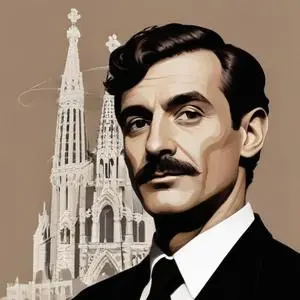
Antoni Gaudí, a Catalan architect, and designer, is renowned for his whimsical and surreal creations that have become synonymous with Barcelona's cityscape. His iconic Sagrada Familia, a Gothic-Art Nouveau hybrid, is an unfinished masterpiece that continues to awe visitors from around the world.
Born on June 25, 1852, in Riudoms or Reus, Spain, Gaudí was the youngest of five children. His father, Francesc Gaud, was a coppersmith, and his mother, Antònia Cornet, was a homemaker. Growing up, Gaudí was fascinated by nature, architecture, and religion, which would later influence his distinctive style.
Gaudí's architectural journey began under the tutelage of Elies Rogent, who instilled in him a passion for Gothic architecture. However, it was his encounter with the Modernista movement that truly ignited his creative spark. He experimented with novel techniques, incorporating ceramics, stained glass, and wrought ironwork into his designs. This fusion of art and architecture led to the development of his signature style, characterized by sinuous lines, organic forms, and a blend of medieval and Oriental influences.
Gaudí's work has inspired generations of architects, designers, and artists. His innovative use of materials, techniques, and forms has left an indelible mark on modern architecture. UNESCO has declared seven of his works as World Heritage Sites, a testament to his enduring influence.
Gaudí's Catholic faith played a significant role in his life and art, earning him the nickname "God's Architect." His dedication to his craft was matched only by his devotion to his faith, which he saw as a means to transcend human limitations.
In 1926, Gaudí's life was cut short when he was struck by a tram in Barcelona. However, his legacy continues to captivate and inspire visitors from around the world. As we gaze upon his surreal creations, we are reminded of the transformative power of art and architecture to uplift and enrich our lives.
"The straight line belongs to men, the curved one to God." — Antoni Gaudí
Born in 1904
A renowned surrealist master of bizarre, dream-like paintings and sculptures that blur reality and fantasy, known for iconic works like "The Persistence of Memory" and "The Elephants".
Born in 1881
A pioneering artist who transformed modern art with pioneering Cubist works, creating a new visual language that continues to inspire and influence art, design, and culture.
94 Years Old
A master of voluminous figures, this artist is renowned for his exaggerated, curvaceous depictions of people, animals, and still-life compositions, blending realism with satire and social commentary.
Born in 1893
A renowned Spanish artist, famous for his vibrant, dreamlike paintings and sculptures that blended abstraction and surrealism, creating a unique visual language. His works often featured bold colors, biomorphic forms, and a sense of playfulness.
Born in 1887
A pioneer of modern architecture, famous for designing innovative, functional, and visually striking buildings that transformed urban landscapes. His works continue to inspire architects and designers worldwide.
