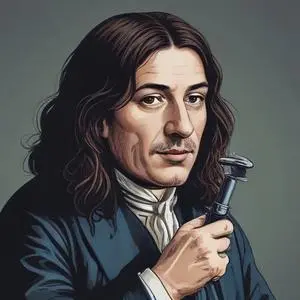
The Father of Microbiology: Antonie van Leeuwenhoek
A Pioneer in the Field of Microscopy and Microbiology
Antonie van Leeuwenhoek, a Dutch microbiologist and microscopist, is commonly known as the Father of Microbiology. He is credited with pioneering work in microscopy and establishing microbiology as a scientific discipline.
Early Life and Career
Born on October 24, 1632, in Delft, Dutch Republic, Van Leeuwenhoek was raised in a family of brewers. His father, Philips Antonisz van Leeuwenhoek, was a basket maker who died when Antonie was only five years old. He was baptized as Thonis on November 4. After his father's death, his mother remarried Jacob Jansz Molijn, a painter.
The Rise of a Self-Taught Scientist
Van Leeuwenhoek worked as a draper in his youth and founded his own shop in 1654. He became well-recognized in municipal politics and developed an interest in lensmaking. In the 1670s, he started to explore microbial life with his microscope.
Groundbreaking Discoveries
Using single-lensed microscopes of his own design and make, Van Leeuwenhoek was the first to observe and experiment with microbes, which he originally referred to as "dierkens," "diertgens," or "diertjes." He was the first to relatively determine their size. Most of the animalcules are now referred to as unicellular organisms, although he observed multicellular organisms in pond water.
Microscopic Observations
Van Leeuwenhoek's discoveries included:
- Microscopic observations of muscle fibers
- Bacteria
- Spermatozoa
- Red blood cells
- Crystals in gouty tophi
He was also among the first to see blood flow in capillaries.
Contributions to Science
Although Van Leeuwenhoek did not write any books, he described his discoveries in numerous letters to the Royal Society, which published many of his letters in their Philosophical Transactions.
Legacy
Antonie van Leeuwenhoek's contributions to the field of microbiology and microscopy are immeasurable. He paved the way for future scientists and inspired generations to come. His work laid the foundation for modern microbiology and continues to impact our understanding of the microbial world.
Personal Milestones and Key Life Events
- 1632: Born in Delft, Dutch Republic
- 1654: Founded his own drapery shop
- 1670s: Started exploring microbial life with his microscope
- 1723: Died on August 26
Influence on Modern Society
Van Leeuwenhoek's discoveries have had a profound impact on modern society. His work has led to significant advancements in fields such as medicine, biology, and ecology.
Philosophical Contributions and Beliefs
Van Leeuwenhoek's pioneering work in microscopy and microbiology has led to a deeper understanding of the natural world. His contributions have inspired new areas of scientific inquiry and continue to shape our understanding of the microbial world.
Career Highlights and Major Works
Van Leeuwenhoek's major works include his discoveries of microbial life, observations of muscle fibers, bacteria, spermatozoa, red blood cells, and crystals in gouty tophi.
Historical Context and Legacy
Antonie van Leeuwenhoek lived during the Golden Age of Dutch science and technology, a time of significant scientific discovery and innovation. His work has had a lasting impact on the scientific community, and he is remembered as one of the most important figures in the history of microbiology.
FAQ
Who is considered the Father of Microbiology?
Antonie van Leeuwenhoek is widely regarded as the Father of Microbiology due to his pioneering work in the field of microbiology, discovering bacteria, yeast, and protists using his handmade microscopes.
What were Antonie van Leeuwenhoeks contributions to microbiology?
Van Leeuwenhoeks contributions to microbiology include the discovery of microorganisms, such as bacteria, yeast, and protists, and his development of techniques for observing microorganisms using microscopes.
How did Antonie van Leeuwenhoek make his microscopes?
Van Leeuwenhoek made his microscopes by hand, using high-quality lenses and a specialized technique that allowed him to achieve high magnification and resolution.
What did Antonie van Leeuwenhoek discover about the human body?
Van Leeuwenhoek discovered that the human mouth contains microorganisms, and he was one of the first scientists to observe and describe the microbiome.
Why is Antonie van Leeuwenhoek important in the history of science?
Van Leeuwenhoek is important in the history of science because he laid the foundation for the field of microbiology, and his discoveries paved the way for significant advances in medicine, biology, and other fields.