


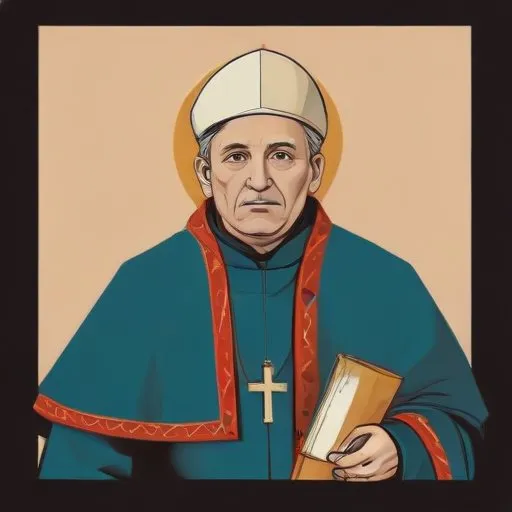
An Italian archbishop and saint who played a key role in the Renaissance, promoting education and reform within the Catholic Church. He's also known for his extensive writings on theology and philosophy.
Antoninus of Florence, a 15th-century Italian Dominican friar, is revered as a saint in the Catholic Church for his tireless efforts in reforming the Dominican Order and promoting a stricter form of life within the faith. As Archbishop of Florence, he left an indelible mark on the city and the Church, earning him a revered place in the annals of Catholic history.
Born Antonio Pierozzi on March 1, 1389, in Florence, Italy, Antoninus was orphaned at a young age when his mother, Tomasina, passed away. His father, Niccol, a prominent notary, ensured that his son received a solid education. The young Antoninus was drawn to the spiritual life, and in 1405, at the age of 16, he joined the Dominican Order at the priory of San Domenico in Fiesole.
Under the guidance of Blessed John Dominici, founder of the community, Antoninus embarked on his novitiate in Cortona, where he was joined by fellow novices, including the renowned artist Fra Angelico. Upon completing his novitiate, he returned to Fiesole, where he remained until 1409, when the Florentines, who had refused obedience to Pope Gregory XII, forced him and his brethren to take shelter in the Convent of Foligno.
Dedicated to promoting a stricter form of life within the Order, Antoninus worked tirelessly to reform various Dominican houses, including those in Cortona, Rome, Naples, and Florence. He played a pivotal role in the establishment of the Congregation of Tuscany, founded by John Dominici, which aimed to revitalize the Dominican Order after the devastating effects of the Western Schism.
In 1430, Antoninus became prior of Santa Maria sopra Minerva, and from 1433 to 1446, he served as vicar of the Congregation. During this period, he was instrumental in establishing the Priory of St. Mark in Florence, which became a hub for spiritual renewal and reform. The priory's cells, including one for Cosimo de Medici, were adorned with frescoes by Fra Angelico, a testament to the artistic and spiritual collaboration that flourished under Antoninus' leadership.
Antoninus of Florence died on May 2, 1459, and was canonized a saint in 1523. He is remembered for his unwavering commitment to reform, his devotion to the faith, and his tireless efforts to promote a stricter form of life within the Dominican Order. His legacy continues to inspire generations of Catholics, and his feast day, May 2, is celebrated by the Church as a testament to his enduring impact.
"The true servant of Christ is he who does the will of God, not his own."
Antoninus' unwavering dedication to reform and spiritual renewal serves as a beacon of inspiration for contemporary Catholics, encouraging them to strive for a deeper commitment to their faith.
Born in 1227
The first Jesuit Pope, he played a key role in establishing the Catholic Church's missionary efforts in Asia and was a strong advocate for the arts, commissioning famous works like the frescoes in the Basilica of St. John Lateran.
Born in 1452
A Dominican friar who preached about moral reform and prophesied the downfall of corrupt rulers, leading a short-lived theocratic government in Florence before being executed. He's known for his fiery sermons and clashes with the powerful Medicis.
