


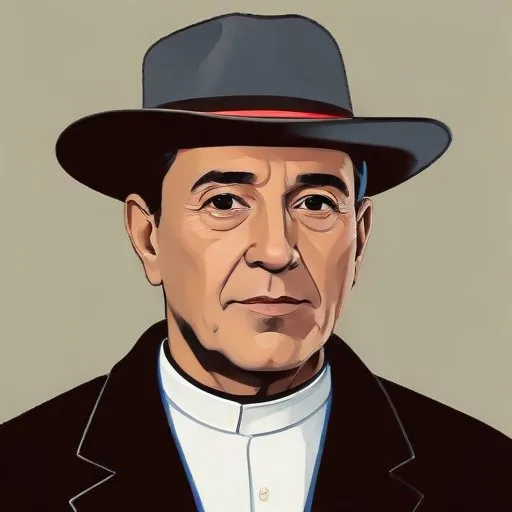
A Spanish-American priest, rancher, and politician who played a key role in New Mexico's early development and served as a delegate to the US Congress, advocating for the rights of Hispanic Americans.
Antonio Jos Martnez, a celebrated priest, educator, publisher, rancher, farmer, community leader, and politician, left an indelible mark on the history of New Mexico. Known for his multifaceted contributions, Martnez played a pivotal role in shaping the region's social, economic, and political landscape during the Spanish, Mexican, and American periods.
Born on January 17, 1793, in Abiquiu, New Mexico, Martnez was raised by his father, Severino, who instilled in him the importance of ranching and farming at the Hacienda Martnez in Northern New Mexico. After his mother's passing, Martnez's father remarried, and the family moved to Taos in 1804.
In 1817, Martnez traveled to the Diocese of Durango to pursue his priestly vocation, enrolling in the Tridentine Seminary. During his six-year tenure, he excelled academically and developed a deep understanding of liberal Mexican politics, influenced by thinkers like Miguel Hidalgo. He was ordained in 1823 and returned to New Mexico, becoming the parish priest of Taos, earning the revered title "Padre Martnez."
Martnez's dedication to education led him to establish the first public school in Taos, providing access to quality education for the local community. He also founded the first newspaper in New Mexico, El Crepúsculo de la Libertad (The Twilight of Liberty), promoting literacy and intellectual discourse. As a rancher and farmer, Martnez introduced new agricultural practices, increasing crop yields and improving the region's food security.
Martnez's impact on modern society is multifaceted. He played a crucial role in shaping New Mexico's cultural identity, promoting education, and fostering community development. His commitment to social justice and equality inspired future generations of leaders and activists. Moreover, his influence on the region's economic development, particularly in agriculture and publishing, continues to be felt to this day.
Martnez's remarkable life and achievements are a testament to his unwavering dedication to the people of New Mexico. His legacy extends beyond the boundaries of his native region, inspiring generations to strive for social justice, education, and community development. As a symbol of New Mexico's rich cultural heritage, Martnez's story continues to captivate and inspire, ensuring his place in the annals of American history.
In an era marked by turbulent political and social change, Martnez's commitment to education, social justice, and community development distinguished him from his contemporaries. While other leaders focused on power and territory, Martnez's vision for a more equitable and educated society set him apart as a true visionary.
Martnez's fascinating life has been immortalized in Willa Cather's novel, Death Comes for the Archbishop, ensuring his legacy extends beyond the realm of history and into the world of literature.
Although Martnez's contributions went largely unrecognized during his lifetime, his legacy has been posthumously celebrated through various awards and honors, cementing his place as one of New Mexico's most revered historical figures.
Antonio Jos Martnez's extraordinary life and achievements serve as a testament to the power of vision, dedication, and community service. As a champion of education, social justice, and equality, his legacy continues to inspire generations, ensuring his place as one of the most beloved and revered figures in New Mexico's history.
