


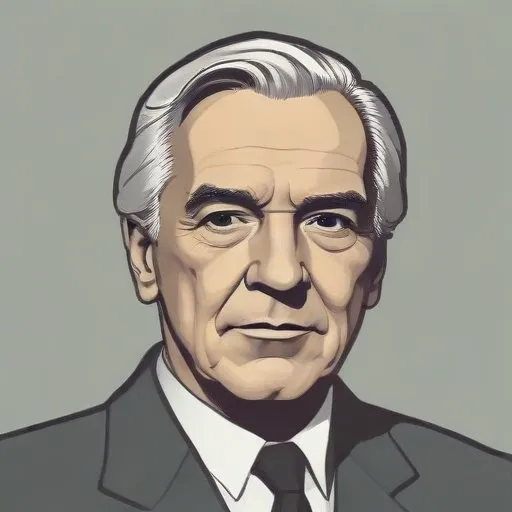
A British historian who developed the theory of civilizations rising and falling in a predictable cycle, and wrote a 12-volume magnum opus on world history.
Arnold J. Toynbee is renowned for his magnum opus, A Study of History, a 12-volume masterpiece that explores the rise and fall of civilizations. As a leading specialist on international affairs, Toynbee's work has had a profound impact on our understanding of human history, culture, and society.
Born on 14 April 1889 in London, England, Toynbee was raised in a family of intellectuals. His mother, Sarah Edith Marshall, was a pioneering figure in women's education, and his sister, Jocelyn Toynbee, was an accomplished archaeologist and art historian.
Toynbee's academic career was marked by numerous achievements, including his appointment as a research professor of international history at the London School of Economics and King's College London.
Toynbee's philosophical approach to history was characterized by his emphasis on the cyclical nature of human civilization, arguing that societies rise and fall in response to challenges and pressures.
Toynbee's work has had a profound impact on modern thought, influencing scholars, policymakers, and thinkers around the world.
Toynbee's personal life was marked by tragedy, including the institutionalization of his father in 1911 and the loss of his wife, Rosalind Murray, in 1964.
Arnold J. Toynbee's legacy extends far beyond his own lifetime, shaping the way we think about history, culture, and human society.
The visionary historian and philosopher of history, Arnold J. Toynbee, leaves behind a rich and enduring legacy, continues to inspire and challenge us to think critically about our place in the world and our responsibilities to future generations.
Born in 1737
Wrote "The History of the Decline and Fall of the Roman Empire", a monumental work that shaped the field of historiography and remains a classic in the study of ancient civilizations.
Born in 1875
Developed the concept of collective unconscious and archetypes, and founded analytical psychology, which emphasizes the integration of opposites and the process of individuation.
Born in 1856
Pioneering psychoanalyst who developed theories on the subconscious mind, childhood experiences, and the structure of personality, revolutionizing our understanding of human behavior and psychology.
Born in 1874
A philosopher who developed the concept of "symbolic forms" to understand human culture and knowledge, and is known for his work on the philosophy of science and the Enlightenment.
Born in 1909
A Latvian-English historian and philosopher who explored the intersection of philosophy, history, and politics, and is renowned for his work on the Enlightenment, liberty, and the nature of humanity.
Born in 1917
A renowned historian and author who wrote extensively on the rise of industrial capitalism and the development of socialist and communist movements in the 19th and 20th centuries. His works provide insightful perspectives on modern history and its complexities.
