


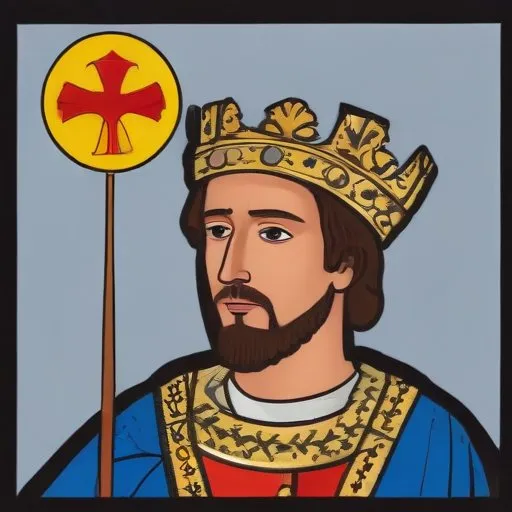
Grandson of King Henry II of England, he fought for Brittany's independence from France and was a key figure in the Anglo-French War. He's remembered for his bravery and strategic military leadership.
Arthur I, Duke of Brittany, is best known for being the posthumous son of Geoffrey II, Duke of Brittany, and Constance, Duchess of Brittany, and his brief but tumultuous reign as the 4th Earl of Richmond and Duke of Brittany from 1196 to 1203. His fascinating story is marked by intrigue, betrayal, and murder, making him one of the most enigmatic figures in medieval history.
Arthur was born on March 29, 1187, to Geoffrey II and Constance, Duchess of Brittany. However, his father died before he was born, making him the posthumous son. As an infant, Arthur was considered second in line to the succession of his paternal grandfather, King Henry II of England, after his uncle Richard.
Henry II's failure to establish clear terms of succession led to uncertainty and power struggles among his sons. This ambiguity would haunt Arthur's life and ultimately seal his fate. When King Henry II died in 1189, Richard I became the new king, leaving Arthur's place in the line of succession unclear.
In 1190, while Richard I was away on the Third Crusade, Constance sought to make the Duchy of Brittany more independent. On November 11, 1190, Arthur was named as Richard's heir presumptive, and he was betrothed to a daughter of King Tancred of Sicily as part of a treaty.
However, Emperor Henry VI's conquest of the Kingdom of Sicily in 1194 nullified the betrothal, leaving Arthur's future uncertain once again.
In 1196, Arthur became the 4th Earl of Richmond and Duke of Brittany, solidifying his position in the nobility. However, his reign was short-lived.
In 1203, Arthur was incarcerated in Rouen Castle, and his fate remains a mystery to this day. It is widely believed that he was killed by his uncle John, who had him either drowned in a lake or stabbed to death in a drunken fury.
Arthur I, Duke of Brittany's, life may have been cut short, but his story has left an indelible mark on medieval history. His tragic fate serves as a reminder of the complexities and uncertainties of royal succession, and the often-brutal nature of power struggles.
Despite his brief reign, Arthur's legacy continues to fascinate historians and enthusiasts alike, serving as a testament to the enduring power of intrigue, betrayal, and mystery.
Arthur I, Duke of Brittany's story is a captivating reminder of the complexities and uncertainties of medieval politics, and the enduring power of mystery and intrigue.
