


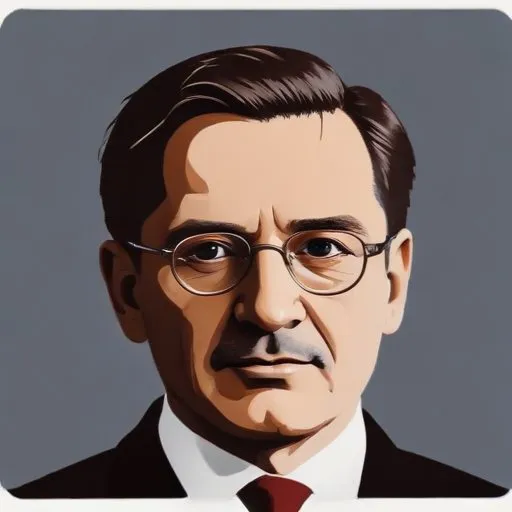
A pioneer in quantum cryptography, developing a secure way to encode and decode messages using quantum mechanics, revolutionizing data encryption and secure communication.
Artur Ekert is renowned for his groundbreaking contributions to the field of quantum physics, particularly in the realm of quantum cryptography. As one of the pioneers in this field, Ekert's research has been instrumental in developing secure communication systems that utilize the principles of quantum mechanics.
Born on September 19, 1961, in Wrocław, Poland, Ekert's fascination with physics began at a young age. He pursued his passion at the Jagiellonian University in Kraków and later at the University of Oxford, where he earned his doctorate degree. During his graduate studies at Wolfson College, Oxford, Ekert's research focused on the application of quantum entanglement and nonlocality in distributing cryptographic keys with perfect security.
In 1991, Ekert was elected a junior research fellow at Merton College, Oxford, and subsequently became a research fellow in 1994. This marked the beginning of his journey in establishing the first research group in quantum cryptography and computation, based in the Clarendon Laboratory, Oxford. This group would later evolve into the Centre for Quantum Computation, now based at DAMTP in Cambridge.
Ekert's most notable work is his proposal for quantum cryptography using entangled photons, which has been widely recognized as a significant breakthrough in the field. His research has opened up new avenues for secure communication, enabling the development of unhackable encryption methods.
Ekert's contributions to quantum physics have been recognized with several prestigious awards, including the Royal Society's Hughes Medal in 1995 and the European Physics Society's EPS Prize for Research into the Fundamentals of Quantum Physics in 1996. He is also a fellow of the Royal Society and the Institute of Physics.
While Ekert's work has been widely acclaimed, some critics have raised concerns about the potential misuse of quantum cryptography. However, Ekert has consistently emphasized the importance of responsible innovation, advocating for the development of ethically sound and secure communication systems.
Ekert's work is deeply rooted in his philosophical belief in the power of fundamental physics to drive technological innovation. He has emphasized the need for interdisciplinary research, encouraging collaboration between physicists, engineers, and computer scientists to tackle complex problems in quantum computing and cryptography.
In addition to his academic achievements, Ekert has held several prestigious positions, including the Lee Kong Chian Centennial Professorship at the National University of Singapore and the founding directorship of the Centre for Quantum Technologies (CQT). He is currently a professor of quantum physics at the Mathematical Institute, University of Oxford, and a professorial fellow at Merton College, Oxford.
Artur Ekert's pioneering work in quantum cryptography has paved the way for a new era of secure communication. As we continue to navigate the complexities of the digital age, Ekert's research serves as a beacon of hope for a more secure and connected future.
Ekert's story serves as a testament to the power of fundamental research and its potential to drive technological innovation. His work is a reminder that even the most groundbreaking discoveries can have a profound impact on our daily lives, and that the boundaries of human knowledge are waiting to be pushed.
84 Years Old
A brilliant mind who unraveled the mysteries of black holes and the universe, making complex physics accessible to all through bestselling books.
95 Years Old
A renowned expert in the fields of physics, mathematics, and philosophy, known for his groundbreaking work on black holes, cosmology, and the nature of consciousness. His theories have reshaped our understanding of the universe and the human mind.
86 Years Old
A Nobel Prize-winning physicist who discovered the Josephson effect, a phenomenon where a current flows between two superconductors separated by a thin insulator, leading to breakthroughs in quantum computing and electronics.
86 Years Old
A Nobel Prize-winning theoretical physicist who pioneered our understanding of black holes, wormholes, and the behavior of matter in extreme conditions.
