


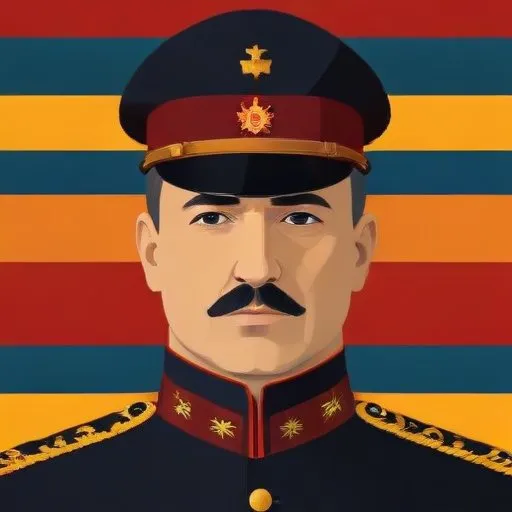
A high-ranking officer in the Waffen-SS, known for his military campaigns on the Eastern Front during World War II, particularly in Romania and Hungary.
Artur Phleps was a high-ranking officer in the Waffen-SS, the military branch of the Nazi Party, during World War II. He is notorious for his involvement in war crimes and crimes against humanity, particularly in Eastern Europe, earning him the distinction of being a senior officer in a criminal organization.
Artur Gustav Martin Phleps was born on November 29, 1881, in Bierta, Austria-Hungary (now Romania). He began his military career in the Austro-Hungarian Army before World War I, specializing in mountain warfare and logistics. By the end of the war, he had risen to the rank of Oberstleutnant (lieutenant colonel).
In the interwar period, Phleps joined the Romanian Army, eventually becoming a Generallocotenent (major general) and adviser to King Carol. However, after speaking out against the government, he was sidelined and eventually dismissed from the army.
In 1941, Phleps joined the Waffen-SS under his mother's maiden name, Stolz, and quickly rose to the rank of SS-Standartenführer (colonel). He saw action on the Eastern Front as a regimental commander with the SS Motorised Division Wiking.
Phleps went on to raise and command the 7th SS Volunteer Mountain Division Prinz Eugen, as well as the 13th Waffen Mountain Division of the SS Handschar (1st Croatian). His units committed numerous atrocities against civilian populations in the Independent State of Croatia, German-occupied territory of Serbia, and Italian governorate of Montenegro.
In his final appointment, Phleps served as plenipotentiary general in south Siebenbürgen (Transylvania) and the Banat, where he organized the evacuation of Volksdeutsche (ethnic Germans) to the Reich.
Phleps was killed in action on September 21, 1944. Posthumously, he was awarded the Oak Leaves to his Knight's Cross of the Iron Cross, in addition to the German Cross in Gold.
At the Nuremberg trials, the Waffen-SS was declared a criminal organization due to its major involvement in war crimes and crimes against humanity. As a senior officer, Phleps' involvement in these atrocities has made him a notorious figure in modern history.
His name is forever linked to the atrocities committed by the Waffen-SS, serving as a grim reminder of the devastating consequences of extremism and militarism.
Born in 1839
The first ruler of Romania, unifying the country and establishing its independence from the Ottoman Empire, known for modernizing and westernizing the nation.
Born in 1921
The last king of Romania, ruling from 1927 to 1930 and again from 1940 to 1947, known for his efforts to resist Soviet influence and his role in the country's transition to communism.
