


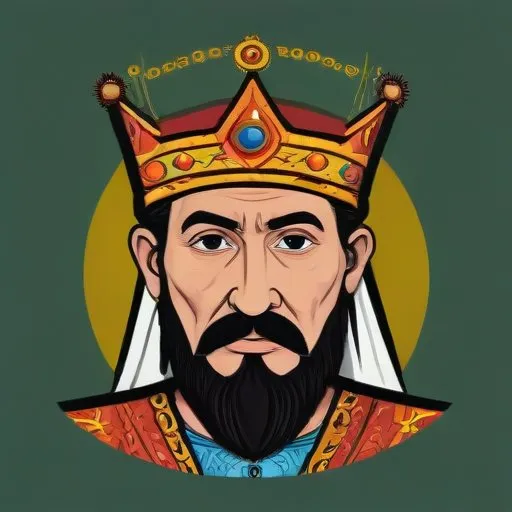
Unifier of western Georgian kingdoms, establishing a strong and stable reign that paved the way for future prosperity.
Bagrat III of Imereti is renowned for his unwavering dedication to protecting his kingdom from the looming threat of the Ottoman Empire, and his remarkable ability to rebuild and strengthen his nation in the face of repeated invasions. As the king of Imereti from 1510 to 1565, he forged a legacy marked by bravery, strategic diplomacy, and a steadfast commitment to preserving the cultural heritage of Western Georgia.
Born in 1495, Bagrat III was the son of Alexander II, the previous king of Imereti. Following his father's demise, Bagrat ascended to the throne in 1510, inheriting a kingdom beset by the Ottoman menace. Despite the challenges, he demonstrated remarkable fortitude and acumen, quickly establishing himself as a shrewd leader capable of navigating the treacherous landscape of regional politics.
Bagrat's reign was punctuated by a series of military campaigns aimed at repelling the Ottoman Empire's incursions into Imereti. In 1512, the Ottomans invaded the kingdom through its southern neighbor, Samtskhe, and besieged the capital, Kutaisi. Undeterred, Bagrat launched a program of restoration, reorganized the church, and implemented a stringent law condemning to death those engaging in slave trading, a practice perpetuated by the Turks and some Georgian nobles.
In 1533, Bagrat orchestrated a joint expedition with Mamia I Gurieli of Guria and Mamia III Dadiani of Mingrelia against the piratical North Caucasian tribe of Zichi, which had fallen under Turkish influence. Although the endeavor proved disastrous, Bagrat remained resolute, subsequently focusing on weakening the Ottoman positions in southern Georgia. He achieved a crucial victory at the Battle of Murjakheti near Akhalkalaki in 1535, defeating and capturing Qvarqvare III Jaqeli, the prince-atabeg of Samtskhe, and annexing a substantial portion of his possessions to Imereti.
Bagrat's diplomatic efforts were characterized by a delicate balancing act, as he sought to forge alliances with neighboring kingdoms while maintaining a delicate truce with the Ottoman Empire. He formed a vital alliance with Rostom, prince of Guria, which enabled him to repel Ottoman invasions on multiple occasions. However, his relationship with Levan I Dadiani, the prince of Mingrelia, was more complicated, as Levan ultimately defected to the Ottoman side, earning gifts and assurances of protection from the Sultan.
Bagrat III's unyielding resistance against the Ottoman Empire earned him a revered place in Georgian history. His military campaigns, although not always successful, showcased his unwavering commitment to defending his kingdom and preserving the cultural identity of Western Georgia. Through his diplomatic efforts, he maintained a fragile peace, ensuring the survival of Imereti as an independent entity amidst the tumultuous landscape of the Caucasus region.
Little is known about Bagrat's personal life, aside from his birth in 1495 and his death in 1565. His reign, marked by a series of military campaigns and diplomatic maneuverings, dominates the existing historical record. However, his legacy as a strong and resilient leader has endured, inspiring generations of Georgians to cherish their cultural heritage and national identity.
Bagrat III's reign coincided with a period of great upheaval in the Caucasus region, as the Ottoman Empire sought to expand its dominion over the region. Against this backdrop, Bagrat's unwavering commitment to Imereti's independence assumes greater significance, underscoring the importance of strong leadership in the face of existential threats. His legacy serves as a testament to the enduring spirit of the Georgian people, who have continued to persevere in the face of adversity, safeguarding their cultural heritage for generations to come.
Bagrat III of Imereti's remarkable story serves as a powerful reminder of the importance of courage, resilience, and strategic leadership in the face of adversity. His legacy continues to inspire Georgians today, as they reflect on the rich cultural heritage and national identity forged by this remarkable king.
