


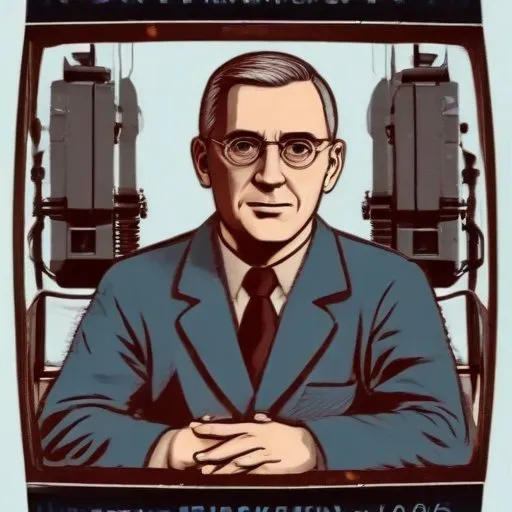
Developed innovative radio technologies, including the first all-electronic television system, and held over 200 patents in radio and television.
Benjamin Franklin Miessner, an American radio engineer and inventor, is best known for his groundbreaking contributions to the world of electronic music. Specifically, he is credited with inventing the electronic organ, electronic piano, and other musical instruments that revolutionized the music industry.
Miessner was born on July 27, 1890, in Huntingburg, Indiana, to Charles and Mary Reutopohler Miessner. He was the brother of Otto Miessner. After completing high school in 1908, Miessner enlisted in the U.S. Navy and graduated from the U.S. Naval Electrical School in Brooklyn, New York, in 1909.
During his time in the Navy, Miessner was assigned to a naval radio station in Washington, D.C., where he worked as a radio operator. It was during this period that he invented the "cat whisker detector," a device that enabled receiving radio waves using crystal sets. This invention earned him a promotion to Chief Operator.
In 1911, Miessner left the Navy to work with John Hays Hammond Jr. and Frtiz Lowenstein on a wireless control system for torpedoes. During this collaboration, he invented the superheterodyne radio system. The team also developed the "Electric Dog," a prop used to demonstrate how light affects the electrical conduction properties of selenium.
Miessner's work with Hammond was cut short due to a falling out, and he went on to study electrical engineering at Purdue University from 1913 to 1916. During this time, he was a member of the Sigma Pi fraternity and communicated with Nikola Tesla about his book on radio dynamics.
In June 1916, Miessner married Eleanor M. Schulz in Buffalo, New York, and they had two daughters, Jane and Mary. That same year, he returned to the Navy as an Expert Radio Aid for Aviation, where he developed radio systems for airplanes. He also published his book "Radiodynamics," which focused on the wireless control of torpedoes and other mechanisms.
Throughout his life, Miessner's work had a significant impact on the development of electronic music. His inventions paved the way for modern electronic instruments, and his contributions to radio technology helped shape the music industry as we know it today.
Benjamin Miessner's legacy extends far beyond his inventions and achievements. He played a crucial role in shaping the music industry, and his work continues to inspire generations of musicians and inventors. His contributions to radio technology and electronic music have had a lasting impact on modern society, making him a true pioneer in his field.
Today, Miessner's work serves as a testament to the power of innovation and creativity, inspiring future generations to push the boundaries of what is possible.
Born in 1873
Invented the Audion tube, a type of vacuum tube that revolutionized radio communication and paved the way for modern electronics. This innovation enabled the amplification of weak electrical signals, transforming the field of communication.
Born in 1874
Developer of the first practical wireless telegraph, pioneering radio communication and earning a Nobel Prize in Physics. Known for revolutionizing long-distance communication.
Born in 1791
Co-inventor of the Morse code, a groundbreaking communication system that revolutionized long-distance communication, and a talented painter who captured the essence of American life.
Born in 1856
A pioneering engineer who harnessed the power of alternating current (AC) to transform the world's electrical systems, and is credited with developing groundbreaking technologies like radio communication and X-ray imaging.
