


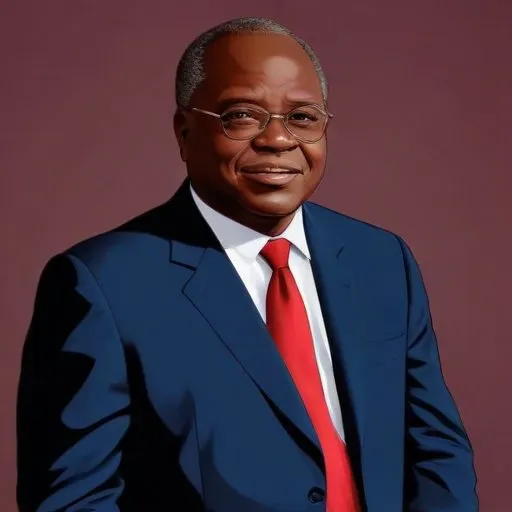
A Tanzanian journalist and politician who served as the 3rd President of Tanzania, known for his efforts to stabilize the country's economy and promote regional peace. He implemented economic reforms, attracting foreign investment and reducing poverty.
Benjamin Mkapa, the third president of Tanzania, is remembered for his unwavering commitment to eradicating corruption and promoting economic growth in his country. During his tenure from 1995 to 2005, Mkapa's administration was marked by significant reforms, privatization, and a quest for foreign investment.
Mkapa was born on November 12, 1938, in Lupaso, near Masasi, Tanganyika. He pursued higher education at Makerere University in Uganda, graduating with a Bachelor of Arts in English in 1962. The following year, he enrolled at Columbia University, where he earned a Master's degree in International Affairs.
Mkapa's career in politics began as an administrative officer in Dodoma. He later served as the Minister for Science, Technology, and Higher Education. His diplomatic experience was further enhanced when he headed the Tanzanian mission to Canada in 1982 and to the United States from 1983 to 1984. Mkapa also served as the Minister of Foreign Affairs from 1977 to 1980 and again from 1984 to 1990.
In 1995, Mkapa was elected president, largely due to his popular anti-corruption campaign and the strong support of former president Julius Nyerere. During his presidency, Mkapa established the Presidential Commission on Corruption, also known as the Warioba Commission, and strengthened the Prevention of Corruption Bureau. These efforts aimed to create a more transparent and accountable government.
Mkapa's administration implemented significant economic reforms, including privatization of state-owned corporations and free market policies. These changes attracted foreign investment, leading to economic growth and the cancellation of some of Tanzania's foreign debts. However, his presidency was not without controversy, as critics accused him of lavish spending, including the purchase of a $15 million private presidential jet and $30 million in military aviation equipment from BAE Systems.
Benjamin Mkapa's legacy is complex, marked by both achievements and criticisms. His anti-corruption efforts and economic reforms have had a lasting impact on Tanzania's development. While his presidency was not without controversy, Mkapa remains an important figure in Tanzanian history, remembered for his commitment to promoting economic growth and reducing corruption.
"Corruption is a cancer that must be eradicated if we want to see real development in our country." - Benjamin Mkapa
Through his remarkable journey, Benjamin Mkapa leaves behind a legacy that continues to shape Tanzania's future. His commitment to anti-corruption efforts and economic reforms will always be remembered as a turning point in the country's history.
Born in 1922
First President of Tanzania, led the country to independence from British colonial rule and implemented socialist policies, known for his Pan-Africanism and anti-colonialism efforts.
66 Years Old
The 5th President of Tanzania, known for his anti-corruption efforts and controversial views on science and health, who implemented various infrastructure projects and sparked debate with his unorthodox approach to governance.
76 Years Old
A Tanzanian leader who served as President from 2005 to 2015, known for his efforts to strengthen the country's economy and promote regional stability. He also played a key role in the East African Community.
Born in 1925
Tanzania's second president, serving from 1985 to 1995, known for introducing economic reforms and transitioning the country from a one-party to a multi-party system. He played a significant role in shaping Tanzania's modern political landscape.
88 Years Old
A renowned international diplomat who led the United Nations from 1997 to 2006, promoting global cooperation and development, and receiving the Nobel Peace Prize in 2001.
