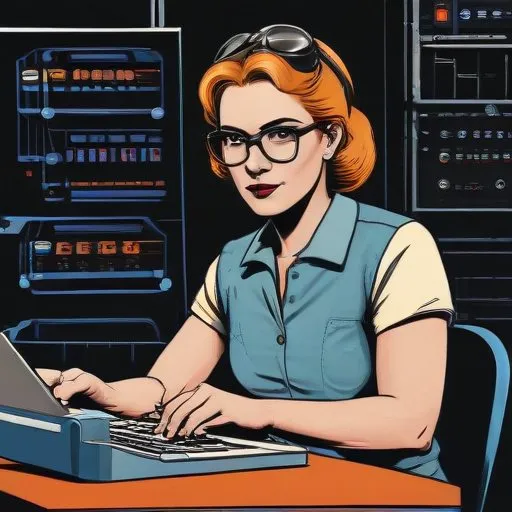
Betty Holberton: The Trailblazing Computer Scientist Behind ENIAC
A Pioneer in Computer Programming
Betty Holberton was one of the six original programmers of the Electronic Numerical Integrator And Computer (ENIAC), the first general-purpose electronic digital computer. She is credited with inventing breakpoints in computer debugging, a technique that revolutionized the way programmers troubleshoot and solve problems.
Early Life and Education
Born Frances Elizabeth Snyder on March 7, 1917, in Philadelphia, Pennsylvania, Holberton was the third child in a family of eight. Her parents,
John Amos Snyder and Frances J. Morrow, instilled in her a love for learning and a strong work ethic. Despite her math professor's suggestion that she would be better off at home raising children, Holberton pursued a degree in journalism, which allowed her to travel and explore her passion for writing.
Career Highlights and Major Works
Holberton's career in computer science began when she joined the ENIAC project in 1942. Due to the project's classified nature, she and her fellow female programmers,
Jean Bartik, Ruth Teitelbaum, Kathleen Antonelli, Marlyn Meltzer, and
Frances Spence, worked with blueprints and wiring diagrams to program the massive machine. Holberton's creative problem-solving skills earned her the nickname "the night thinker," as her colleagues often joked that she solved more problems in her sleep than others did awake.
After World War II, Holberton went on to work at Remington Rand and the National Bureau of Standards. In 1959, she became the Chief of the Programming Research Branch, Applied Mathematics Laboratory at the David Taylor Model Basin.
Impact on Modern Society
Holberton's contributions to the development of UNIVAC, the first commercially available computer, paved the way for the modern computer industry. Her design of control panels, which placed the numeric keypad next to the keyboard, set a standard for computer design that remains in use today. Additionally, she persuaded engineers to replace the Univac's black exterior with a gray-beige tone, which became the universal color of computers.
Personal Milestones and Key Life Events
- 1946: ENIAC is unveiled at the University of Pennsylvania, with Holberton and her team receiving recognition for their groundbreaking work.
- 1959: Holberton becomes the Chief of the Programming Research Branch, Applied Mathematics Laboratory at the David Taylor Model Basin.
- 2001: Holberton passes away on December 8, leaving behind a legacy as a pioneering female computer scientist.
Legacy and Inspirational Story
Betty Holberton's remarkable career serves as an inspiration to future generations of computer scientists, particularly women. Her pioneering work on ENIAC and UNIVAC paved the way for the development of modern computers, and her legacy continues to motivate women to pursue careers in STEM fields. As a trailblazing female computer scientist, Holberton's story serves as a reminder of the importance of diversity and inclusion in the tech industry.
FAQ
What was Betty Holbertons role in the development of COBOL?
Betty Holberton was a key figure in the development of COBOL, one of the first high-level programming languages. She was part of the team that designed the language and contributed to its development in the 1950s.
What was Betty Holbertons background before becoming a programmer?
Before becoming a programmer, Betty Holberton worked as a mathematician and statistician at the National Advisory Committee for Aeronautics (NACA), where she developed algorithms for aerodynamics and other applications.
How did Betty Holberton contribute to the development of ENIAC?
Betty Holberton was one of the six original programmers of Electronic Numerical Integrator And Computer (ENIAC), the first general-purpose electronic computer. She worked alongside other notable programmers like Jean Jennings Bartik and Kathleen McNulty Mauchly Antonelli.
What awards and recognition did Betty Holberton receive for her work?
Betty Holberton received numerous awards and recognition for her contributions to computer science, including being inducted into the Women in Technology International Hall of Fame and receiving theAda Lovelace Award.
What legacy did Betty Holberton leave in the field of computer science?
Betty Holbertons legacy in computer science is significant, as she paved the way for future generations of women in technology. Her work on COBOL and ENIAC helped establish her as a pioneer in the field, and her contributions continue to inspire women in STEM fields.