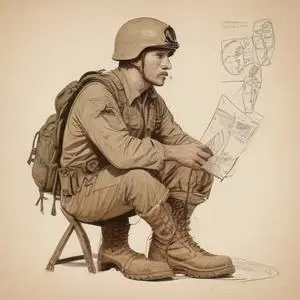
Bill Mauldin: The Cartoonist Who Captured the Soul of War
A Master of Satire and Social Commentary
Bill Mauldin is renowned for his unflinching and poignant editorial cartoons that humanized the struggles of World War II soldiers, earning him two Pulitzer Prizes and a permanent place in the annals of American cartooning history. Through his iconic characters Willie and Joe, Mauldin brought the everyday experiences of war-weary infantrymen to the forefront, transcending the boundaries of newsprint and resonating with both soldiers and civilians alike.
A Life of Art and Service
Born on October 29, 1921, in Mountain Park, New Mexico, Mauldin was drawn to the world of art and service from a young age. His family's rich military heritage, which included his father's service in World War I and his grandfather's role as a civilian scout in the Apache Wars, instilled in him a deep respect for the sacrifices made by those in uniform.
In 1937, Mauldin moved to Phoenix, Arizona, where he began his foray into editorial journalism, writing for the Coyote Journal at Phoenix Union High School. This early start laid the groundwork for his future success as a cartoonist.
The War Years: Willie and Joe Take Center Stage
Mauldin's enlistment in the Arizona National Guard in 1940 marked the beginning of his most significant creative period. As a member of the 45th Infantry Division, he volunteered to work for the unit's newspaper, where he created the characters that would become synonymous with his name: Willie and Joe.
These two weary and stoic infantrymen, often depicted in the midst of mundane yet hazardous duties, captured the hearts of soldiers across Europe and civilians back in the United States. Mauldin's cartoons offered a relatable and humanizing portrayal of war, one that resonated deeply with those who served and those who waited anxiously at home.
Awards and Accolades
- 1945: First Pulitzer Prize for his wartime cartoons
- 1959: Second Pulitzer Prize for a cartoon published in The St. Louis Post-Dispatch
A Lasting Legacy
Mauldin's work extends far beyond the realm of wartime cartoons. His contributions to the world of editorial cartooning are immeasurable, having influenced generations of cartoonists and satirists. His commitment to social commentary and his unwavering dedication to capturing the human experience have cemented his status as a true American treasure.
As we reflect on Mauldin's remarkable career, we are reminded of the power of art to capture the essence of our shared human experience. Through his cartoons, Mauldin gave voice to the voiceless, offering a poignant and unvarnished portrayal of war that continues to resonate with audiences today.
Selected Works and Exhibitions
- Up Front (1945): A collection of Mauldin's wartime cartoons
- Back Home (1947): A post-war collection of cartoons
- "I'll Get By" (1958): A cartoon published in The St. Louis Post-Dispatch, for which Mauldin received his second Pulitzer Prize
- Library of Congress exhibition (2003): A retrospective of Mauldin's work, showcasing his cartoons and sketches from World War II to the present day
A Life Well-Lived
Bill Mauldin passed away on January 22, 2003, leaving behind a legacy that continues to inspire and educate. His cartoons, which continue to be syndicated and exhibited around the world, serve as a testament to the enduring power of satire and social commentary.
FAQ
What was Bill Mauldins most famous cartoon character?
Bill Mauldins most famous creation was Willie and Joe, two wisecracking, weary infantrymen who reflected the experiences and attitudes of ordinary soldiers during World War II.
What was Bill Mauldins role in the US Army?
Bill Mauldin served in the US Army during World War II, where he began drawing cartoons for the military newspaper Stars and Stripes. His work was so popular that he was eventually given his own column, Up Front.
What awards did Bill Mauldin win for his cartoons?
Bill Mauldin won two Pulitzer Prizes for his editorial cartoons, in 1945 and 1959. He was also awarded the Legion of Merit for his contributions to morale during World War II.
How did Bill Mauldins experiences in World War II influence his cartooning?
Bill Mauldins experiences during World War II deeply influenced his cartooning, giving him a unique perspective on war and its impact on ordinary people. His cartoons offered a gritty, humorous, and humane portrayal of life on the front lines.
What was Bill Mauldins legacy in American cartooning?
Bill Mauldins legacy is that of a pioneering cartoonist who used his talents to capture the essence of war and its human cost. His work continues to inspire cartoonists and artists today.