


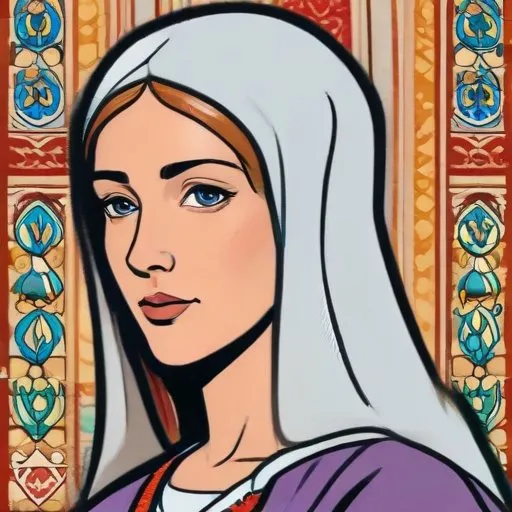
Blanche of France, Duchess of Orleans, is renowned for being the last direct member of the House of Capet, a dynasty that ruled France for over 300 years. Born posthumously to King Charles IV of France and his third wife, Joan of Evreux, Blanche's life was marked by a series of events that would shape the course of French history.
Blanche's birth in 1328 was significant, as it came just after her father's demise. Her uncle, Philip of Valois, took advantage of the situation and claimed the throne, sparking a controversy that would last for years to come. This event also led to the establishment of a rule that would bar women from inheriting the throne, a law that would have far-reaching consequences for generations to come.
In 1345, Blanche married her second cousin, Philip, Duke of Orleans, a union that would prove childless. Despite this, Philip had illegitimate children, ensuring that his lineage would continue. The couple's marriage was a strategic move aimed at strengthening family ties and securing the Orleans title.
Blanche's life was marked by luxury and isolation. As a member of the royal family, she was afforded every comfort and privilege. However, her childlessness and the tumultuous nature of her family's history often relegated her to the background. She spent most of her days residing in the palace of Orleans, surrounded by opulence and extravagance.
Blanche of France, Duchess of Orleans, passed away on February 8, 1393, at the age of 65. She was buried in the chapel of Notre-Dame in the Basilica of St. Denis, alongside other members of the royal family. Her death marked the end of the direct line of the House of Capet, paving the way for the rise of cadet branches.
Blanche's family tree is a complex web of relationships and alliances. Her parents were King Charles IV of France and Joan of Evreux, the daughter of Louis, Count of Evreux, and Margaret of Artois. Through her marriage to Philip, Duke of Orleans, she became part of the Orleans branch of the royal family.
Blanche of France, Duchess of Orleans, may not have had children of her own, but her life and legacy had a profound impact on French history. Her story is a testament to the complex and often tumultuous nature of royal dynasties, and serves as a reminder of the intricate web of relationships and alliances that shaped the course of European history.
Born in 1052
King of France from 1060 to 1108, known for his military campaigns and conflicts with the Church, particularly his excommunication by Pope Urban II.
Born in 1214
King of France from 1226 to 1270, leading the Seventh and Eighth Crusades, and establishing a strong, centralized government. He's also revered for his justice and piety.
Born in 1165
King of France from 1180 to 1223, known for his military conquests, including the Battle of Bouvines, and his role in the Third Crusade.
Born in 1710
The monarch who ruled France from 1715 to 1774, known as the "Sun King's" great-grandson, and remembered for his extravagance, absolutism, and the decline of the French monarchy.
Born in 1319
King of France from 1350 to 1364, known for being captured by the English during the Hundred Years' War and later ransomed.
Born in 1052
King of France from 1060 to 1108, known for his military campaigns and conflicts with the Church, particularly his excommunication by Pope Urban II.
Born in 1338
The King of France from 1364 to 1380, known for his military victories and rebuilding of Paris, earning him the nickname "Charles the Wise".
