


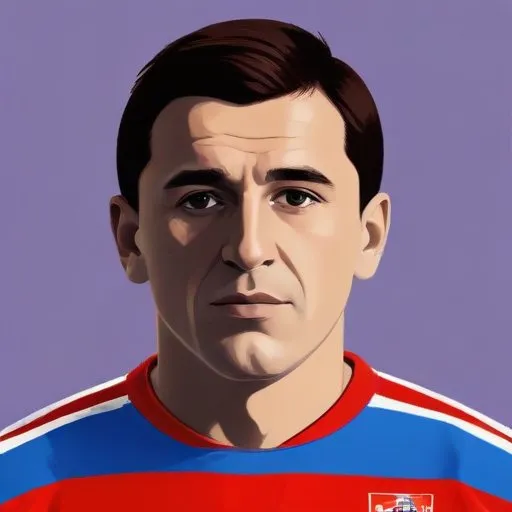
A renowned football player and coach, known for his successful stints with Dinamo Zagreb and Hajduk Split, as well as his tenure as the Yugoslav national team coach.
Branko Zebec, a Croatian footballer and manager, left an indelible mark on the world of football with his exceptional skills and impressive performances during the 1950s. He is best known for his remarkable career with Yugoslavia, Partizan, and Red Star Belgrade, as well as his successful stints as a coach with Hajduk Split, Bayern Munich, and Hamburger SV.
Zebec's journey in football began in his hometown of Zagreb, where he played for various teams, including Graanski Zagreb, Potar Zagreb, Lokomotiva Zagreb, and Borac Zagreb. In 1951, he received a call from Partizan, one of the dominant teams in Yugoslav football, which marked the beginning of his illustrious career.
Zebec's speed, agility, and understanding of the game earned him a spot on the left wing of Partizan, and soon, he became an integral part of the team. During his time with Partizan, he won three Yugoslav Cups (1952, 1954, and 1957). He also played a crucial role in the team's second-place finish in the championship in 1954. Zebec's exceptional performance led to his transfer to Red Star Belgrade, where he won the national championship in 1960.
Zebec's impressive performance at the club level led to his inclusion in the Yugoslavian national team, where he featured 65 times, scoring 17 goals. He represented Yugoslavia in the 1952 Summer Olympics in Helsinki, where he became the top scorer with seven goals, helping the team secure a silver medal. Zebec also participated in the 1954 FIFA World Cup in Switzerland, where Yugoslavia reached the quarterfinals, and the 1958 FIFA World Cup in Sweden.
Zebec's successful playing career paved the way for his coaching endeavors. He led Hajduk Split, Bayern Munich, and Hamburger SV to success, showcasing his adaptability and ability to thrive in different environments.
Zebec's exceptional speed was complemented by his impressive athleticism, allowing him to run 100 meters in 11 seconds with football boots. He was known for his versatility, able to play almost every outfield position on the pitch.
Zebec's playing style was characterized by his physical abilities, tactical awareness, and understanding of the game. He was a firm believer in the importance of adaptability, speed, and agility in football, which earned him recognition as one of the greatest players of his generation.
Zebec's remarkable career has inspired countless footballers and coaches, leaving a lasting impact on the sport. His versatility, athleticism, and tactical awareness have become benchmarks for modern players, while his coaching success has influenced the development of football strategies.
Zebec's achievements are set against the backdrop of a tumultuous period in European football history, marked by the rise of Hungarian football and the dominance of Yugoslavian teams. His contributions to the sport have cemented his place as one of the greatest players and coaches of the 20th century, ensuring his legacy continues to inspire future generations of football enthusiasts.
Born in 1922
First President of Croatia, leading the country to independence from Yugoslavia, and known for his role in shaping modern Croatian identity.
47 Years Old
Croatian footballer who played as a midfielder and managed several clubs, including Hajduk Split and Dinamo Zagreb, known for his success in Croatian football.
58 Years Old
Croatian striker who played for top European clubs like Real Madrid and Arsenal, scoring crucial goals in major tournaments, including the 1998 World Cup.
56 Years Old
Former Croatian footballer who played as a defender and won several titles with clubs like Lazio and Middlesbrough, also earning 40 caps for the Croatian national team.
59 Years Old
A Croatian footballer and manager who played for Hajduk Split and the Croatian national team, and later managed clubs like West Ham United and Hajduk Split.
