


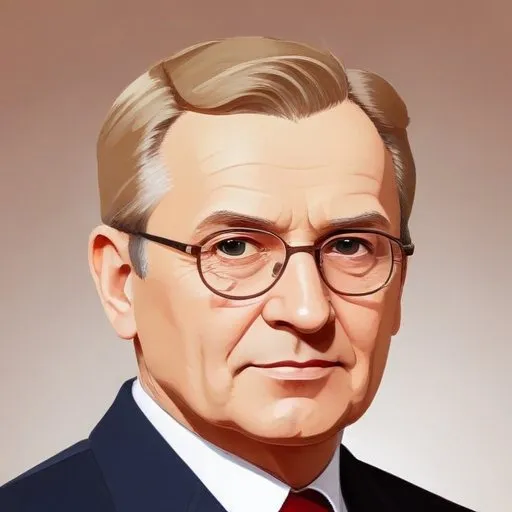
A Polish historian and politician who served as the 5th President of Poland, known for his efforts to strengthen Poland's ties with the European Union and NATO. He played a key role in shaping Poland's foreign policy and promoting national unity.
Bronisław Komorowski, the renowned Polish politician and historian, is widely recognized for his pivotal role in shaping the country's modern history. As the President of Poland from 2010 to 2015, he played a crucial part in stabilizing the nation during a period of turmoil.
Born on June 4, 1952, in Oborniki Śląskie, Poland, Komorowski hails from a family of intellectuals. His father, Zygmunt Leon Komorowski, was a professor of African Studies at the University of Warsaw, while his mother, Jadwiga Komorowska (née Szalkowska), was a homemaker. Komorowski's early years were spent in Józefów near Otwock and Pruszków, where he developed a strong sense of social responsibility.
During the Polish People's Republic era, Komorowski actively participated in the democratic movement as an underground publisher. He collaborated with Antoni Macierewicz on the monthly journal Gos, which advocated for democratic reforms. In 1980, Komorowski was sentenced along with other activists of the Movement for Defense of Human and Civic Rights.
Komorowski's commitment to democracy earned him a seat in the Polish parliament, the Sejm, in 1991. He went on to serve as the Minister of Defense from 2000 to 2001, where he implemented significant reforms to modernize the Polish military. Following the tragic death of President Lech Kaczyński in 2010, Komorowski, as Marshal of the Sejm, assumed the duties of the head of state.
In the 2010 presidential election, Komorowski emerged victorious, becoming the first candidate from the Civic Platform party to hold the office. During his presidency, he prioritized economic growth, EU integration, and strengthening Poland's international relationships.
Komorowski's presidency was marked by significant achievements, including the country's accession to the European Union's Schengen Area, the consolidation of the country's financial system, and the promotion of cultural exchange programs. His commitment to democracy and human rights has inspired a generation of Poles.
Komorowski met his wife, Anna Duda, through Scouting, an organization he was deeply involved with during his youth. The couple has five children together.
Komorowski's presidency can be seen as a watershed moment in Polish history, marking a transition from the post-communist era to a more integrated and Europeanized Poland. His leadership style and policies can be compared to those of other European leaders, such as Germany's Angela Merkel, who also navigated complex economic and political landscapes during their tenure.
Komorowski's unwavering commitment to democracy and human rights serves as an inspiration to people worldwide. His personal motto, "to serve Poland and the Polish people," embodies his selfless dedication to the nation.
77 Years Old
The 4th President of Poland, a strong advocate for conservative values and a key figure in the country's post-communist transition, known for his efforts to strengthen Poland's ties with the EU and NATO.
69 Years Old
The 14th Prime Minister of Poland, a journalist-turned-politician who played a key role in shaping the country's post-communist era and later became a prominent EU leader. He's known for his strong stance on European integration and criticism of authoritarianism.
69 Years Old
The first female Prime Minister of Poland, serving from 2014 to 2015, known for her efforts to strengthen the country's economy and healthcare system.
