


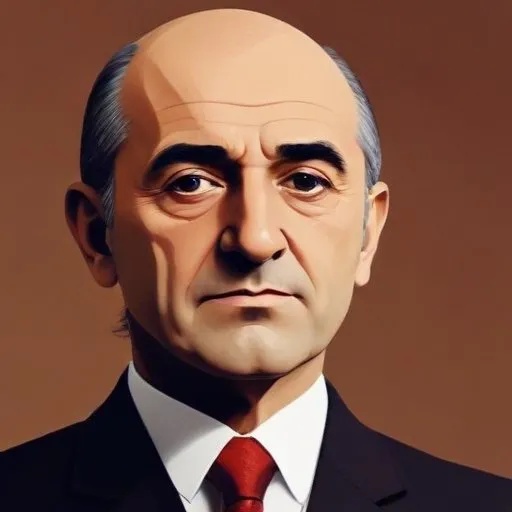
A Turkish-Armenian oil magnate and art collector who founded the Lisbon-based Gulbenkian Foundation, supporting arts, education, and healthcare globally. His vast art collection is renowned for its rarity and historical significance.
Calouste Gulbenkian, affectionately known as "Mr. Five Per Cent," was a British-Armenian businessman and philanthropist who played a pivotal role in unlocking the petroleum reserves of the Middle East, revolutionizing the global energy landscape. His shrewd business acumen and strategic partnerships enabled Western nations to tap into the region's vast oil resources, earning him a reputation as a trailblazer in the oil industry.
Gulbenkian's fascination with oil dated back to his early days in the Caucasus, where his father, Sarkis Gulbenkian, was already an established oil importer and exporter. The younger Gulbenkian soon leveraged his family's connections to forge partnerships with global oil majors, ultimately securing a 5% stake in the Turkish Petroleum Company (TPC), hence the nickname "Mr. Five Per Cent."
This calculated move enabled Gulbenkian to wield significant influence over the Middle East's oil reserves, earning him the respect of oil moguls and governments alike. His business acumen was matched only by his unwavering commitment to philanthropy, as he channeled vast portions of his wealth towards education, healthcare, and the arts.
In 1956, Gulbenkian established the Calouste Gulbenkian Foundation, a behemoth of a private foundation headquartered in Portugal. The foundation's mission was twofold: to promote the arts, education, and science, while also providing humanitarian aid to those in need. Today, the foundation stands as one of the largest and most respected in Europe, with a vast portfolio of initiatives that reflect Gulbenkian's eclectic interests.
Gulbenkian's peripatetic lifestyle took him from the ornate streets of Istanbul to the salons of Paris, and finally, to the picturesque hills of Lisbon. Along the way, he amassed an impressive collection of art, antiquities, and rare books, which would eventually become one of the world's most prized private collections.
His opulent lifestyle was matched only by his boundless curiosity, as he traveled extensively, absorbing the cultures and traditions of the world. From the ornate churches of Armenia to the majestic mosques of Istanbul, Gulbenkian's journeys were a testament to his insatiable thirst for knowledge and beauty.
Calouste Gulbenkian's life was a testament to the power of vision, perseverance, and philanthropy. As one of the wealthiest individuals of his time, he could have easily indulged in grandeur, but instead, he chose to leave a lasting impact on humanity. Today, his foundation stands as a beacon of hope, inspiring future generations to emulate his example of generosity and compassion.
In a world where oil and wealth often dominate the headlines, Gulbenkian's legacy serves as a poignant reminder that true greatness is not measured by wealth or influence, but by the positive impact we have on the lives of others.
Born in 1906
Greek shipping magnate who built a massive fleet and married Jacqueline Kennedy, becoming a symbol of luxury and power. Known for his extravagant lifestyle and business acumen.
Born in 1892
Founded the Getty Oil Company and amassed a vast art collection, becoming one of the richest people in the world. He's also known for his frugal lifestyle despite his immense wealth.
Born in 1839
Founded the Standard Oil Company, revolutionizing the oil industry and amassing vast wealth, which he later used for philanthropic efforts. He's remembered for his business acumen and generosity.
Born in 1835
A self-made industrialist who amassed a vast fortune in the steel industry, then donated most of it to fund over 2,500 public libraries and other philanthropic endeavors.
Born in 1794
Built railroad empires, revolutionizing transportation and commerce, and donated extensively to education and the arts.
Born in 1763
A German-American mogul who built a fur trading empire and invested in real estate, amassing a vast fortune, which he later used to support the arts and education.
Born in 1863
Founded the pioneering automobile manufacturing company that revolutionized the industry with the assembly line production method, making cars more affordable and accessible to the masses.
Born in 1802
Collector of Finnish folklore and compiler of the Kalevala, a 19th-century epic poem that shaped Finnish national identity.
