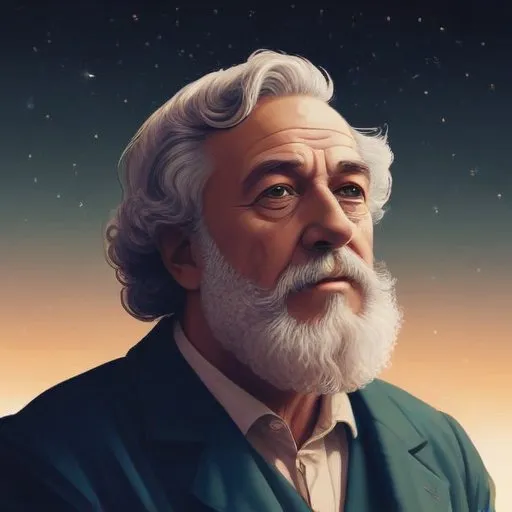
Camille Flammarion: The French Astronomer Who Redefined the Cosmos
The Science Fiction Pioneer and Astronomical Visionary
Camille Flammarion, a French astronomer and author, is renowned for his groundbreaking contributions to the field of astronomy, science fiction, and psychical research. With a prolific writing career spanning over five decades, Flammarion authored more than 50 titles, including popular science works, early science fiction novels, and treatises on spiritualism and the supernatural.
Early Life and Career
Born on February 26, 1842, in Montigny-le-Roi, Haute-Marne, France, Flammarion was the brother of Ernest Flammarion, the founder of the Groupe Flammarion publishing house. In 1858, he became a computer at the Paris Observatory, marking the beginning of his illustrious career in astronomy.
The Founder of the Société Astronomique de France
In 1887, Flammarion founded the Société Astronomique de France, an organization dedicated to promoting astronomical research and education. As its first president, he oversaw the publication of the society's journal, BSAF (Bulletin de la Société Astronomique de France).
A Pioneering Astronomer and Science Fiction Author
Flammarion's literary career was marked by a unique blend of scientific rigor and fantastical imagination. His early science fiction novels, such as
Astronomie populaire (1880) and
L'Étoile (1882), showcased his capacity to merge scientific principles with fictional narratives. His work not only popularized astronomy among the masses but also inspired a new generation of science fiction writers.
The Flammarion Engraving: A Timeless Icon
One of Flammarion's most enduring legacies is the iconic Flammarion engraving, which first appeared in his 1888 edition of
L'Atmosphère. This captivating illustration, depicting a sphere of knowledge breaking through the boundaries of human understanding, has become a symbol of humanity's quest for knowledge and exploration.
Psychical Research and Spiritualism
Flammarion's fascination with the supernatural and the unknown led him to explore the realm of psychical research and spiritualism. His works, such as
Les Mains invisibles (1907), demonstrate his commitment to understanding the mysteries of the human psyche and the nature of consciousness.
Influence on Modern Society
Flammarion's contributions to astronomy, science fiction, and psychical research have had a profound impact on modern society. His work has inspired generations of scientists, writers, and thinkers, shaping our understanding of the cosmos and our place within it.
Personal Milestones and Legacy
Throughout his life, Flammarion maintained a private observatory at Juvisy-sur-Orge, France, where he continued to observe the celestial bodies and ponder the mysteries of the universe. He passed away on June 3, 1925, leaving behind a rich legacy that continues to inspire and fascinate people to this day.
Quotes and Memorable Sayings
- "The universe is not only stranger than we think, it is stranger than we can think."
- "The unknown is an abyss, and the abyss is the unknown."
Trivia and Fun Facts
- Flammarion was one of the first scientists to propose the existence of life on Mars.
- He believed that dwellers on Mars had tried to communicate with Earth in the past.
- Flammarion's writings on spiritualism and psychical research were widely popular in the early 20th century.
FAQ
What were Camille Flammarions contributions to astronomy?
Camille Flammarion was a French astronomer and writer who made significant contributions to the field of astronomy, including the discovery of several celestial objects and the popularization of astronomy through his writings.
What were Camille Flammarions views on space and the universe?
Camille Flammarion was a pioneer in the field of astrobiology, believing that life existed elsewhere in the universe. He wrote extensively on the subject, proposing theories on the origins of life and the possibility of extraterrestrial life.
What was Camille Flammarions role in the development of astronomy in France?
Camille Flammarion was a prominent figure in French astronomy, helping to establish the Astronomical Society of France and promoting astronomical research and education. He also founded the journal LAstronomie, which became a leading publication in the field.
What was Camille Flammarions relationship with other scientists?
Camille Flammarion was a respected figure in the scientific community, corresponding with prominent scientists such as Henri Poincaré and Pierre-Simon Laplace. He was also a member of several scientific organizations, including the French Academy of Sciences.
What is Camille Flammarions legacy in modern astronomy?
Today, Camille Flammarion is remembered as a pioneering astronomer and science communicator. His works continue to inspire astronomers and astrobiologists, and his legacy is celebrated through various awards and institutions named after him.