


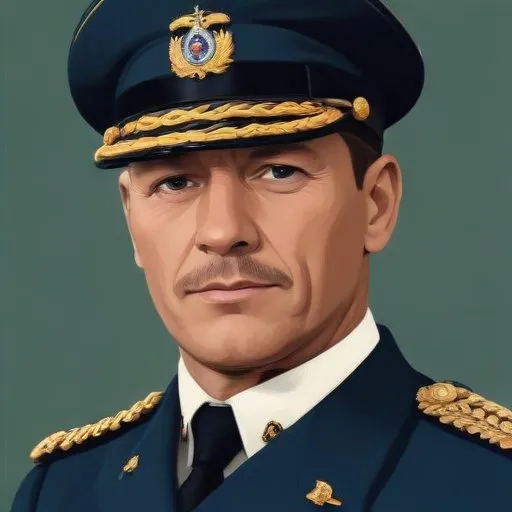
A Swedish nobleman and military leader who served as a general and governor, known for his bravery and strategic skills during the Napoleonic Wars and the Finnish War. He played a key role in shaping Sweden's military and politics during the late 18th and early 19th centuries.
Carl Gustaf Armfeldt is renowned for his unwavering bravery and unrelenting spirit during the Great Northern War, where he played a pivotal role as a Swedish general and friherre (baron) in the Finnish army. Despite facing numerous challenges and setbacks, Armfeldt's determination and military prowess earned him a lasting legacy in the annals of Swedish history.
Born on November 9, 1666, in Swedish Ingria, Armfeldt was destined for a life of military service, following in the footsteps of his father, Lieutenant Colonel Gustaf Armfelt. At just 17 years old, he joined the Nylands kavalleri as a cadet, laying the foundation for his future success.
In 1685, Armfeldt left Sweden to seek new opportunities in France, where he joined Prince Ferdinand of Fürstenberg's regiment as a footsoldier. Over the next 12 years, he honed his military skills, eventually returning to Sweden as a captain.
In 1701, Armfeldt's extensive military experience earned him a position as generaladjutant in the Finnish army, where he remained for most of the Great Northern War. His leadership skills and bravery in battle led to his promotion to commander of the Finnish army in 1713.
One of Armfeldt's most notable achievements during this period was his defense of Helsingfors in 1713, although he faced defeat at the battle of Storkyro in 1714 against an overwhelming Russian force.
In 1717, Armfeldt was promoted to lieutenant general and tasked with leading a Swedish force into Norway to capture Trondheim, following the orders of King Charles XII. However, after the king's untimely death at Fredriksten, Armfeldt was left to face the harsh realities of war alone.
The ensuing disaster, known as the Carolean Death March, would become a defining moment in Armfeldt's career. With poorly equipped troops, Armfeldt led his force into the treacherous Norwegian mountains, where a severe blizzard struck, killing hundreds of soldiers. Of the over 5,000 men who set out, only 2,100 survived the ordeal.
In 1719, Armfeldt was appointed governor of Viborg county, a position he held until his death on October 24, 1736.
Despite the challenges and setbacks, Armfeldt's unwavering dedication to his country and his troops has cemented his place in Swedish history as a brave and revered military leader.
Carl Gustaf Armfeldt's legacy serves as a testament to his unwavering courage and dedication to his country, earning him a revered place in the annals of Swedish history.
Born in 1746
King of Sweden from 1771 to 1792, known for his cultural and artistic achievements, and his assassination at a masquerade ball. He was a patron of the arts and a strong leader who modernized Sweden's government and economy.
Born in 1829
King of Sweden and Norway from 1872 to 1907, known for his diplomatic efforts to maintain Scandinavian unity and neutrality during the tumultuous late 19th century.
