


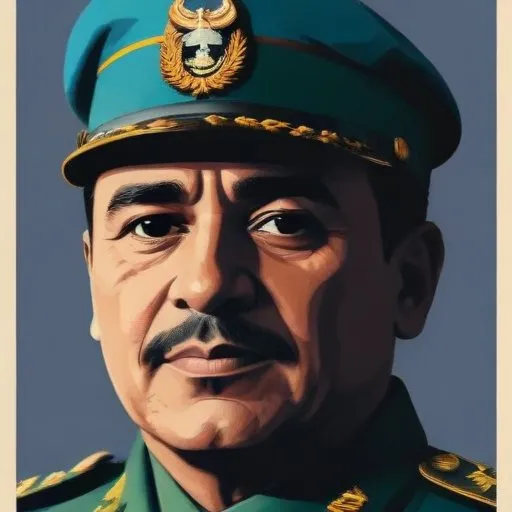
A Guatemalan general and politician who served as President of Guatemala from 1970 to 1974, known for his authoritarian rule and human rights abuses. He implemented a state of siege and used military force to suppress opposition.
Carlos Manuel Arana Osorio, a military officer and politician, served as the 35th president of Guatemala from 1970 to 1974, leaving a legacy of human rights violations and state terrorism. His government enforced torture, disappearances, and killings against political and military adversaries, as well as common criminals, earning him the reputation as one of the most repressive leaders in Guatemalan history.
Born on July 17, 1918, in Barberena, Santa Rosa, Arana came from a military family; his uncle, Francisco Javier Arana, was a former head of the Guatemalan armed forces. Arana followed in his uncle's footsteps, becoming a Colonel in the Army and overseeing counterinsurgency efforts in Zacapa and Izabal from 1966 to 1968, where thousands were killed by the military.
In July 1970, Arana became president following an electoral process widely considered non-transparent, promising to crack down on law and order issues and bring stability to the country. His vice president was Eduardo Cceres.
In November 1970, Arana imposed a State of Siege, followed by heightened counterinsurgency measures. His government committed severe human rights violations, including detaining, disappearing, torturing, and extrajudicially executing political opponents, student leaders, suspected guerrilla sympathizers, and trade unionists. The Guatemalan Human Rights Commission estimated that 20,000 Guatemalans were killed or disappeared under the Arana administration.
Arana's government received large-scale military support from the United States, including weapons, technical support, and military advisors. This support has been widely criticized, with many arguing that the US was complicit in Arana's human rights abuses.
Carlos Manuel Arana Osorio's regime marked the beginning of a string of Institutional Democratic Party military rulers who would dominate Guatemalan politics in the 1970s and 1980s. His government's human rights abuses and state terrorism have left a lasting impact on Guatemalan society, and his legacy continues to be felt today.
Arana was a freemason and served as the ambassador to Nicaragua after his presidency. Little is known about his personal life, but his public life was marked by controversy and violence.
Arana's presidency occurred during a tumultuous period in Guatemalan history, marked by civil war and political unrest. His government's actions have been widely condemned, and he remains a controversial figure in Guatemalan history.
Carlos Manuel Arana Osorio's presidency was marked by human rights abuses, state terrorism, and controversy. While his legacy is complex and multifaceted, it is undeniable that his actions had a profound impact on Guatemalan history and society.
Born in 1895
Guatemalan leader who ruled with an iron fist, suppressing opposition and sparking a civil war that lasted for decades. He's infamous for his brutal regime and human rights abuses.
