


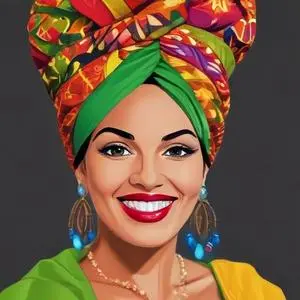
A vibrant performer who dazzled audiences with her exotic style, signature fruit-adorned turbans, and lively Latin rhythms, becoming a cultural icon of the 1940s and 1950s.
Carmen Miranda was a Portuguese-born Brazilian singer, dancer, and actress who took Hollywood by storm with her vibrant stage presence, exotic clothing, and signature fruit hats. She was known for her energetic performances, charming Lusophone accent, and iconic Baiana image, earning her the nickname "The Brazilian Bombshell."
Miranda was born Maria do Carmo Miranda da Cunha on February 9, 1909, in Porto, Portugal. She moved to Brazil with her family at a young age and grew up in Rio de Janeiro. Before pursuing a career in entertainment, Miranda designed clothes and hats in a boutique.
In 1929, she made her debut as a singer, recording with composer Josu de Barros. Her 1930 recording of "Ta Pra Voc Gostar de Mim," written by Joubert de Carvalho, catapulted her to stardom in Brazil as the foremost interpreter of samba.
In 1939, Broadway producer Lee Shubert offered Miranda an eight-week contract to perform in "The Streets of Paris" after seeing her at Cassino da Urca in Rio de Janeiro. This opportunity marked the beginning of her international career.
The following year, she made her first Hollywood film, "Down Argentine Way," with Don Ameche and Betty Grable. Her exotic clothing and Lusophone accent became her trademark, and she was voted the third-most-popular personality in the United States.
In 1943, Miranda starred in Busby Berkeley's "The Gang's All Here," which featured musical numbers with the fruit hats that became her trademark. By 1945, she was the highest-paid woman in the United States.
Miranda made 14 Hollywood films between 1940 and 1953. Some of her notable films include:
Although her popularity waned by the end of World War II, Miranda's impact on Hollywood and popular culture remains significant. She was a trailblazer for Latin American artists in the United States and paved the way for future generations of performers.
Miranda was married to David Alfred Sebastian, an American businessman, from 1947 until her death in 1955. She was known for her charitable work, particularly in support of the Brazilian community in the United States.
Miranda passed away on August 5, 1955, at the age of 46, due to a heart attack. She was buried in Rio de Janeiro, and her legacy continues to inspire new generations of artists and performers.
Carmen Miranda's glamorous and vibrant spirit continues to captivate audiences today, and her legacy as "The Brazilian Bombshell" remains an integral part of Hollywood history.
Born in 1895
A visionary behind iconic movie musicals, crafting elaborate dance numbers and pioneering the use of overhead shots and montage sequences. Known for extravagant, kaleidoscopic productions that redefined the genre.
Born in 1904
A stunning beauty and talented actress, she was the first Latin American crossover star in Hollywood, starring in films like "Ramona" and "Bird of Paradise" during the 1920s-1930s.
Born in 1907
A charming, mustachioed actor who brought iconic villains to life, most notably the Joker in the 1960s Batman TV series.
Born in 1915
A glamorous leading lady of 1930s and 1940s Hollywood, starring in musicals and dramas, with a signature sultry voice and striking beauty.
Born in 1908
A legendary actress who dominated Hollywood's Golden Age with her powerful performances and iconic roles in films like "All About Eve" and "What Ever Happened to Baby Jane?"
Born in 1908
A charismatic leading man of Hollywood's Golden Age, starring in films like "The Alexander's Ragtime Band" and "Oscar"-winning "Cocoon", bringing charm and wit to romantic comedies and musicals.
Born in 1913
A talented actor and singer who starred in classic films like "The Postman Always Rings Twice" and brought a new level of realism to Hollywood's Golden Age. Known for his brooding, intense performances that captivated audiences.
Born in 1916
A legendary actor and producer who brought iconic characters to life on screen, starring in over 100 films, including classics like "Gilda" and "3:10 to Yuma".
