


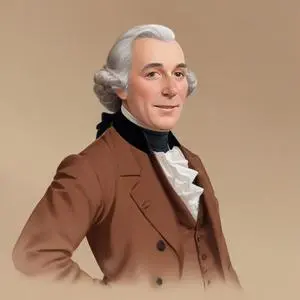
One of the Founding Fathers, signer of the Declaration of Independence, and the only Catholic to do so, playing a key role in shaping America's early years.
Charles Carroll, a prominent American statesman from Annapolis, Maryland, is renowned for building the majestic Baltimore colonial home, Mount Clare, in 1760. As a delegate to the Second Continental Congress in 1776 and 1777, Carroll played a pivotal role in shaping the country's early history.
Descended from the last Gaelic Lords of Ireland, Carroll was born on March 22, 1723, into a distinguished Roman Catholic family. His father, also Charles Carroll, took him to Europe in 1733 for his education, where he spent six years at the English House school in Lisbon, Portugal. Later, he attended Eton and Cambridge, graduating in 1746.
After completing his education, Carroll returned to Annapolis and began to manage the family's farm and mills at Carrollton. However, in 1751, he decided to pursue a career in law, journeying to London to study at the Middle Temple. Admitted to the bar at the Inns of Court, Carroll returned to Maryland in 1755, but never practiced law in the US. Instead, he took his father's seat in the Maryland Assembly, becoming one of the wealthiest men in Maryland after his father's passing in 1755.
In 1760, Carroll completed the construction of his summer home and estate, Mount Clare, located southwest of Baltimore. This majestic colonial home, named after the Irish district of County Clare, showcased Carroll's vision and ambition. The estate, situated along the Georgetown Road (now Washington Boulevard), was a testament to his innovative approach to architecture and landscape design.
Carroll's contributions to American history extend beyond his architectural achievements. As a delegate to the Second Continental Congress, he played a crucial role in shaping the country's early years. His commitment to public service and his ability to bridge the gap between his Roman Catholic heritage and the predominantly Protestant American society earned him a unique place in the annals of American history.
Carroll's life and achievements are set against the backdrop of a tumultuous period in American history. His commitment to public service, his vision for Mount Clare, and his ability to navigate the complexities of his Roman Catholic heritage in a predominantly Protestant society make him a fascinating figure. As we reflect on his legacy, we are reminded of the power of visionary leadership and the enduring impact of courageous individuals on the course of history.
Born in 1737
First Governor of Massachusetts, instrumental in American independence and famously signed the Declaration of Independence with a large, bold signature .
Born in 1722
A leading figure in the American Revolution, he played a key role in shaping the country's independence and democracy. He's also famous for his Boston Beer Company, which still brews his namesake beer today.
Born in 1743
The principal author of the Declaration of Independence and a strong advocate for individual liberties and limited government, shaping America's foundational principles. He oversaw the Louisiana Purchase, doubling the country's territory.
79 Years Old
A Pulitzer Prize-winning composer, known for blending minimalism with complex rhythms, creating a unique sound that resonates with audiences worldwide.
Born in 1736
A pioneering figure in American history, he played a key role in the American Revolution and is famous for declaring "Give me liberty or give me death!" in a speech that helped galvanize the colonial resistance against British rule.
Born in 1732
The first President of the United States, a military hero who led the country to independence, and set the standard for the office of the presidency. He's known for his honesty, integrity, and leadership skills.
Born in 1706
A founding father of the United States, he was a leading figure in the Enlightenment, known for his groundbreaking inventions, scientific discoveries, and influential writings. He played a key role in shaping American history and politics.
Born in 1751
The 4th President of the United States, often referred to as the "Father of the Constitution," played a crucial role in drafting the US Constitution and Bill of Rights, shaping the country's government and laws. He was a strong advocate for individual liberties and limited government power.
