


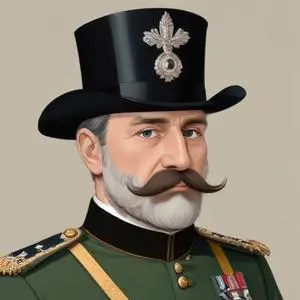
A British army officer who led military campaigns in Africa and China, and later became the governor of Sudan, known for his bravery and heroism during the Siege of Khartoum.
Charles George Gordon, widely known as Chinese Gordon, Gordon Pasha, and Gordon of Khartoum, was a British Army officer and administrator who left an indelible mark on the world. His unwavering bravery, exceptional leadership, and unshakeable commitment to his duties earned him widespread recognition and admiration, making him one of the most celebrated figures of the 19th century.
Born on January 28, 1833, in Woolwich, Kent, Gordon came from a family of military heritage. He was the son of General Henry William Gordon and Elizabeth Enderby Gordon. He received his education at the Royal Military Academy in Woolwich, graduating in 1852.
Gordon's military career began during the Crimean War, where he played a crucial role as an officer in the British Army. However, it was his exceptional leadership in China that earned him the nickname "Chinese Gordon." He led the Ever Victorious Army, a force of Chinese soldiers led by European officers, to numerous victories against the Taiping Rebellion. His remarkable achievements in China earned him honors from both the Emperor of China and the British government.
Gordon entered the service of the Khedive of Egypt in 1873 with British government approval and later became the Governor-General of the Sudan. During his tenure, he worked tirelessly to suppress revolts and the local slave trade, earning him the respect and admiration of the Sudanese people.
In 1884, Gordon was sent to Khartoum with instructions to secure the evacuation of loyal soldiers and civilians. However, in defiance of these instructions, he retained a smaller group of soldiers and non-military men, determined to defend the city against the Mahdi's forces. The subsequent siege lasted for almost a year, during which Gordon and the Mahdi exchanged letters. The Mahdi requested Gordon to convert to Islam and join him, but Gordon declined, opting to defend the city to the end.
The British government, under public pressure, eventually sent a relief force to Khartoum. However, it arrived two days after the city had fallen, and Gordon had been killed. His bravery and resilience in the face of overwhelming odds earned him a place in the annals of history as a true hero.
Gordon's selfless sacrifice and unwavering commitment to his duties inspired generations to come. He was a true leader, a fearless warrior, and a champion of justice and humanitarian causes. His legacy extends far beyond his military achievements, as he continues to inspire people around the world with his courage, resilience, and unwavering dedication to his principles.
"I am a man of action, and I will not be deterred by the enemy or the elements."
Gordon's bravery, leadership, and selflessness continue to inspire people around the world. His legacy serves as a beacon of hope, reminding us of the importance of standing up for what is right, even in the face of overwhelming odds.
Gordon's remarkable life and achievements are a testament to the power of courage, leadership, and unwavering commitment to one's principles. His legacy continues to inspire generations, reminding us of the importance of standing up for what is right, even in the face of overwhelming odds.
Born in 1820
Pioneering nurse and statistician who revolutionized healthcare by introducing sanitation practices and data-driven decision making, becoming the founder of modern nursing.
Born in 1809
Led the United States through its Civil War and ultimately abolished slavery, leaving a lasting legacy in American history.
Born in 1822
Led the Union Army to victory in the Civil War and later became President, known for issuing the Emancipation Proclamation and strengthening federal authority.
Born in 1807
Led the Confederate States Army during the American Civil War, surrendering to Union forces at Appomattox, marking the war's effective end.
Born in 1811
The son of Napoleon Bonaparte, he was the titular Emperor of the French from 1811 to 1832, although he never actually ruled. He's known for his brief, tumultuous life and mysterious death.
Born in 1806
A visionary engineer who revolutionized transportation with innovative designs, including the iconic Clifton Suspension Bridge, which transformed urban landscapes.
