


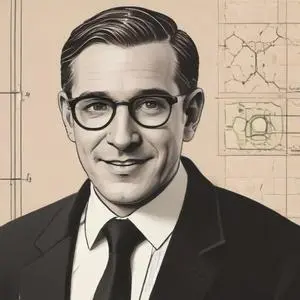
Developed the Kittel model, a fundamental concept in solid-state physics, and wrote influential textbooks on physics, shaping the education of generations of physicists.
Renowned for his groundbreaking contributions to the field of solid state physics, Charles Kittel is the celebrated author of the classic textbook "Introduction to Solid State Physics," a staple in the education of physics students worldwide. His pioneering work on ferromagnetism and the RKKY interaction has left an indelible mark on the scientific community.
Born on July 18, 1916, in New York City, Kittel's intellectual curiosity was nurtured from a young age. He attended the prestigious Horace Mann School for Boys, graduating in 1934, before moving on to the Massachusetts Institute of Technology (MIT) as a chemistry major. However, it was at St John's College, Cambridge, where he switched to physics and earned his Bachelor of Arts degree in 1938.
Kittel's academic journey continued at the University of Wisconsin-Madison, where he obtained his Doctor of Philosophy degree in 1941 under the supervision of Gregory Breit. During World War II, he joined the Submarine Operations Research Group (SORG) and served in the United States Navy as a naval attaché. After the war, he returned to MIT as a research associate, followed by a stint at Bell Laboratories, New Jersey, where he delved into ferromagnetism.
In 1951, Kittel joined the University of California, Berkeley, where he taught and conducted research in theoretical solid state physics. This fruitful period saw the publication of his seminal textbook, which has undergone eight editions to date. He held the position until his retirement in 1978, when he became professor emeritus.
In 1938, Kittel married Muriel A. Lister, an English literature student at Cambridge. They had three children together. Throughout his life, Kittel was guided by a deep passion for physics and a commitment to sharing his knowledge with future generations. His legacy extends far beyond his immense contributions to solid state physics, inspiring countless students and researchers to pursue careers in science.
"The most important thing in science is not so much to obtain new facts as to discover new ways of thinking about them." - Charles Kittel
Kittel's work has had a profound impact on our understanding of the physical world, influencing the development of numerous technologies, from magnetic storage devices to solar cells. His textbook continues to shape the education of physics students, perpetuating a cycle of innovation and discovery.
Charles Kittel's remarkable life and achievements serve as a testament to the power of human curiosity and the boundless potential of the scientific mind. As we continue to build upon his legacy, we honor his memory and the profound impact he has had on our world.
Born in 1908
Developed the transistor and pioneered superconductivity, revolutionizing modern electronics and earning two Nobel Prizes in Physics.
96 Years Old
A pioneer in superconductivity, he discovered the Cooper pair, a phenomenon where electrons team up to enable superconductivity, revolutionizing our understanding of materials and energy transmission.
Born in 1918
A brilliant physicist and engineer who pioneered quantum mechanics and famously explained complex concepts in simple terms, making science accessible to all.
96 Years Old
A pioneer in particle physics, discovering subatomic particles like quarks and gluons, and developing the theory of quantum chromodynamics.
Born in 1923
A renowned physicist and mathematician who made groundbreaking contributions to quantum electrodynamics and futurism, proposing innovative ideas like the Dyson sphere.
84 Years Old
A brilliant mind who unraveled the mysteries of black holes and the universe, making complex physics accessible to all through bestselling books.
95 Years Old
A renowned expert in the fields of physics, mathematics, and philosophy, known for his groundbreaking work on black holes, cosmology, and the nature of consciousness. His theories have reshaped our understanding of the universe and the human mind.
Born in 1921
A Soviet physicist and dissident who advocated for human rights and nuclear disarmament, earning a Nobel Peace Prize in 1975. He's known for his courageous stance against the Soviet regime, promoting peace and democracy.
