


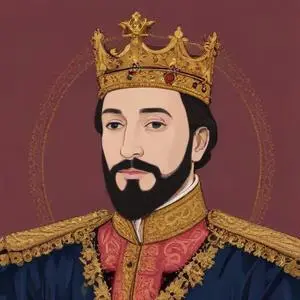
King of France from 1380 to 1422, known for his mental health issues and erratic behavior, which led to power struggles and ultimately, the English occupation of France.
Charles VI, nicknamed the Beloved and later the Mad, was the King of France from 1380 until his death in 1422. He is infamous for his mental illness and psychotic episodes that plagued him throughout his life, making him a complex and intriguing figure in French history.
Charles VI ascended the throne at the tender age of 11, following the death of his father, Charles V. Despite his youth, he inherited a favorable military situation, with the reconquest of most English possessions in France. Initially, the king was placed under the regency of his uncles, the Dukes of Burgundy, Anjou, Berry, and Bourbon.
In 1392, while leading a military expedition against the Duchy of Brittany, Charles had his first attack of delirium, during which he attacked his own men in the forest of Le Mans. A few months later, he narrowly escaped death from burning at the Bal des Ardents in January 1393. These episodes marked the beginning of his struggles with mental illness, which would continue to affect him throughout his life.
Power struggles plagued Charles' reign, as he alternated between periods of mental instability and lucidity. His influential uncles and his wife, Queen Isabeau of Bavaria, held significant control over the kingdom. His younger brother, Louis I, Duke of Orléans, also vied for power, contributing to the enmity between the Armagnac and Burgundian factions. This rivalry eventually led to the devastating Armagnac-Burgundian Civil War of 1407-1435.
In 1415, Charles' army was crushed by the English at the Battle of Agincourt, a significant defeat that would have far-reaching consequences. The king subsequently signed the Treaty of Troyes, which disinherited his son, the Dauphin and future Charles VII, in favor of his future son-in-law Henry V of England. Henry was thus made regent and heir to the throne of France, solidifying English influence over the kingdom.
Charles' marriage to Queen Isabeau was marked by power struggles and controversy. His younger brother, Louis I, Duke of Orléans, was a constant thorn in his side, vying for control of the kingdom. Despite these challenges, Charles remained at the center of the French monarchy, his legacy shaped by the turbulent events of his reign.
Charles VI's reign was marked by turmoil and strife, but it also laid the groundwork for the eventual rise of the French monarchy. His struggles with mental illness and power dynamics continue to fascinate historians and scholars today. Despite his flaws, Charles remains an important figure in French history, a testament to the complexities of human nature and the challenges of leadership.
Charles VI of France remains an enigmatic figure, marked by both brilliant moments and devastating setbacks. His reign was a complex web of power struggles, mental illness, and personal relationships, shaping the course of French history in lasting ways. Despite his flaws, Charles' legacy continues to captivate and inspire, a testament to the enduring power of human resilience and determination.
Born in 1371
A powerful and ambitious duke who ruled Burgundy in the 15th century, known for his military conquests and role in the Hundred Years' War.
Born in 1401
Queen of England from 1420 to 1422, married to King Henry V and mother of King Henry VI, playing a crucial role in the Hundred Years' War.
Born in 1386
Led a victorious English army in the Battle of Agincourt, a major English victory in the Hundred Years' War, and was a popular king who strengthened the English monarchy.
Born in 1052
King of France from 1060 to 1108, known for his military campaigns and conflicts with the Church, particularly his excommunication by Pope Urban II.
Born in 1319
King of France from 1350 to 1364, known for being captured by the English during the Hundred Years' War and later ransomed.
Born in 1412
A French heroine who led the French army to several victories during the Hundred Years' War, and was later canonized as a saint after being burned at the stake for heresy.
